

Discord vs Skool vs Circle for Paid Communities
Choosing a platform for your paid community is one of the first major decisions you'll make as a creator, coach, consultant, educator, or business owner. It's also one of the most confusing. Ask ten different community owners which platform is best and you'll probably get ten different answers. Some will tell you Discord is unmatched. Others will insist Skool is the future. A few will swear by Circle and refuse to use anything else. The problem is that most platform comparisons focus on features rather than outcomes.
- People compare course hosting.
- They compare community feeds.
- They compare pricing.
- They compare integrations.
While those things matter, they don't answer the question most community owners are actually trying to solve.
Which platform will create the best experience for my members?
That's the question that matters. Because members don't join communities because of software. They join communities because they want something. They want to learn. They want to network. They want accountability. They want support. They want access. They want results.
The platform simply becomes the environment where those things happen. This is why there isn't a universal winner between Discord, Skool, and Circle.
- Each platform was designed with different priorities.
- Each platform creates a different member experience.
- Each platform shines under different circumstances.
Understanding those differences is far more valuable than trying to determine which platform has the longest feature list.
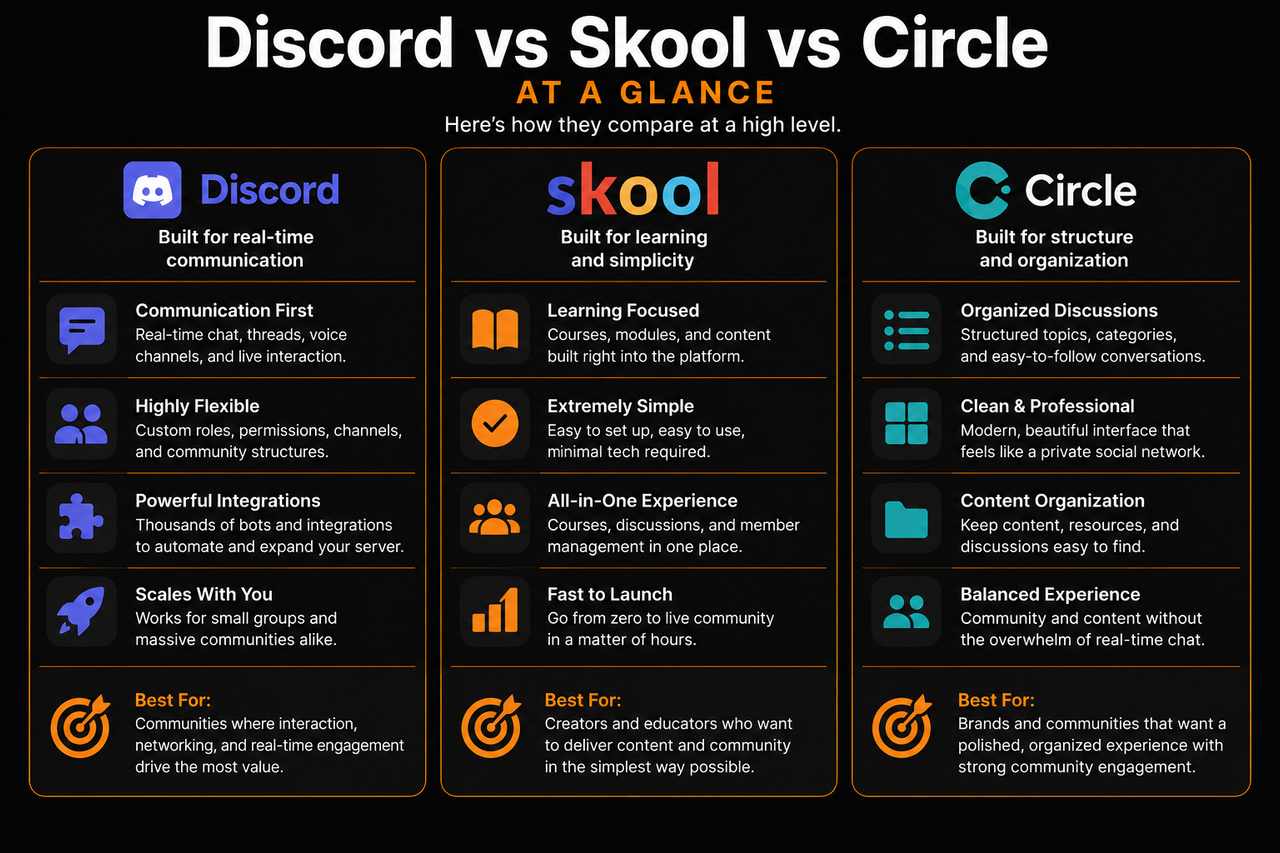
Discord vs Skool vs Circle at a Glance
When people first compare Discord, Skool, and Circle, they often assume they're competing products. Technically, that's true. In practice, they're solving different problems. The reason these comparisons become so difficult is because all three platforms fall under the broad category of "community platforms" while approaching community building from completely different directions.
Discord began as a communication platform. Everything about Discord revolves around interaction.
- Text channels.
- Voice channels.
- Live discussions.
- Events.
- Conversations.
The platform was designed to keep people talking. As creators started building paid communities, they discovered that Discord's engagement levels were difficult to replicate elsewhere. What began as a gaming platform gradually evolved into one of the most popular community platforms on the internet.
Skool took a different path.
Rather than building around conversation, it built around education. Courses and community became the core experience. Instead of asking:
How do we create more interaction?
Skool asked:
How do we make learning communities simpler?
The result was a platform that combines content, courses, and discussions into a single environment.
- Everything is streamlined.
- Everything is simplified.
- Everything is designed to reduce friction for creators and members alike.
Circle sits somewhere between the two.
It focuses heavily on organization and presentation. The platform feels more like a private social network than a chat application.
- Discussions are structured.
- Content is organized.
- The user experience feels polished and professional.
Many creators choose Circle because it provides a clean environment without requiring the amount of setup that Discord often demands. This difference in philosophy is important because it influences every aspect of the member experience.
- A member joining Discord immediately sees conversations.
- A member joining Skool immediately sees structure.
- A member joining Circle immediately sees organization.
None of these approaches are inherently better. They're simply optimized for different goals.
One of the biggest mistakes community owners make is choosing a platform based on what other people are doing.
- A creator sees a successful Discord community and assumes Discord must be the answer.
- Someone else sees a thriving Skool group and immediately begins migrating their members.
- Another person sees Circle being recommended online and assumes it's the professional choice.
The reality is that successful communities are usually successful because of the people running them, not because of the platform they're using. A poorly managed community can fail on any platform. A well-run community can succeed on almost any platform.
The platform matters.
But execution matters more.
This is why community goals should always come before platform selection. Before evaluating software, ask yourself a few questions.
- What type of experience am I trying to create?
- How important are conversations?
- Will members primarily consume content or interact with each other?
- Do I need courses?
- Do I need advanced customization?
- How much setup am I willing to manage?
- How large do I expect the community to become?
The answers to those questions often reveal the best platform long before you begin comparing features.
Another important factor is simplicity versus flexibility. Many community owners assume more flexibility automatically means better.
That's not always true.
Flexibility creates options. It also creates complexity.
Discord offers enormous freedom.
- You can create custom roles.
- You can build elaborate onboarding systems.
- You can automate workflows.
- You can segment members in countless ways.
- You can integrate third-party tools.
- You can design almost any community structure imaginable.
For some communities, that's incredibly valuable. For others, it's unnecessary.
Skool sits at the opposite end of the spectrum. There are fewer decisions to make.
- Fewer things to configure.
- Fewer opportunities to break something.
The tradeoff is reduced flexibility. Circle attempts to balance both worlds. It offers more customization than Skool while remaining more structured than Discord. The best choice often comes down to how much control you want.
Some creators love flexibility. Others prefer simplicity. Neither preference is wrong. The challenge is understanding which one aligns with your goals.
First impressions also play a bigger role than many people realize.
When a member joins your community, they're immediately trying to answer a few questions.
- Where do I start?
- What should I do first?
- Who should I talk to?
- How does this community work?
The easier those questions are to answer, the smoother the onboarding experience becomes. Some platforms naturally provide more structure.
Others require community owners to create that structure themselves. This isn't necessarily a weakness. It's simply another consideration. The most successful communities are rarely built by choosing the "best" platform. They're built by choosing the platform that best supports the experience the creator wants to deliver.
That's the lens through which Discord, Skool, and Circle should be evaluated. Not as competitors fighting for a single crown. But as different tools designed for different types of communities.
Where Each Platform Wins
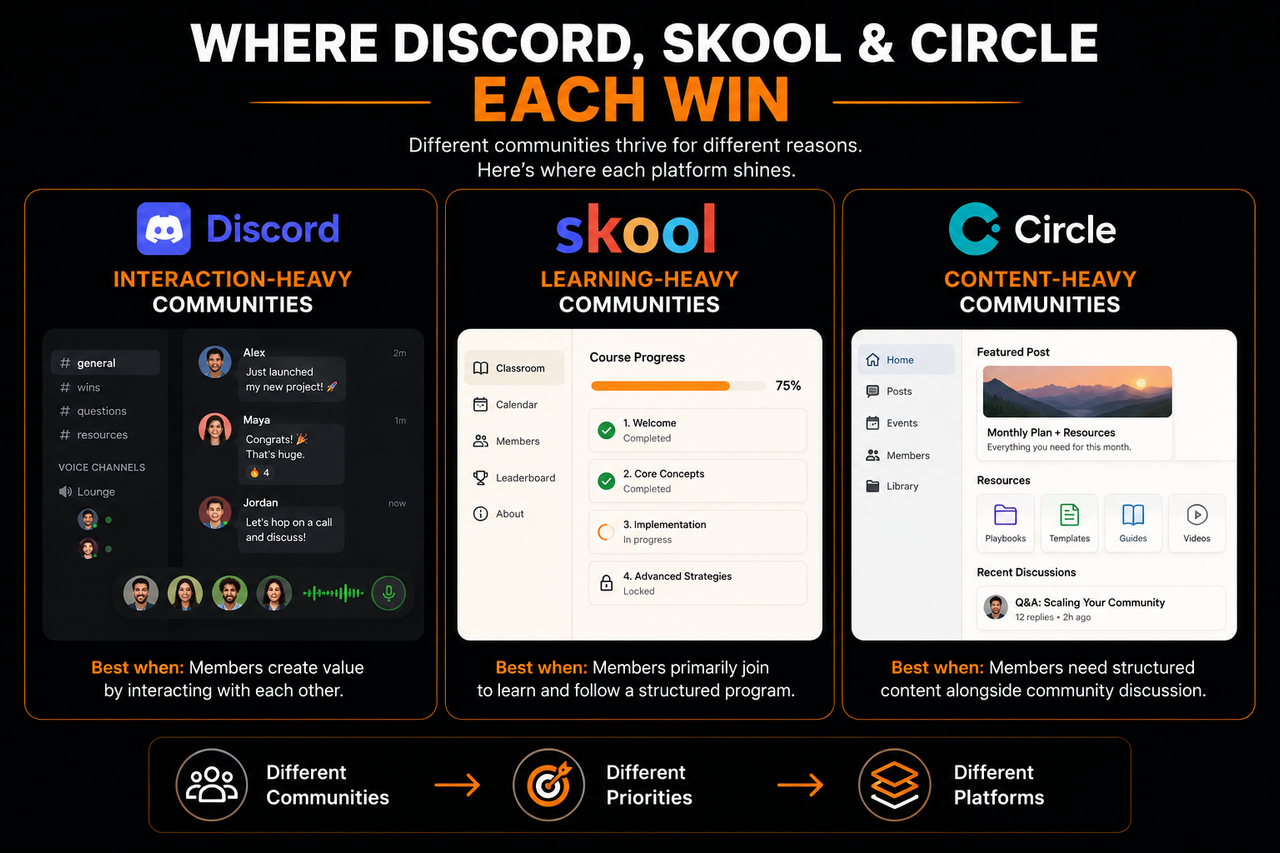
One of the biggest reasons platform comparisons become unproductive is because people spend too much time trying to identify a winner. The reality is that Discord, Skool, and Circle all succeed for different reasons.
Each platform has strengths. Each platform has weaknesses. And each platform tends to attract different types of community owners. Instead of asking which platform is best, it's more useful to ask:
What is each platform best at?
Once you understand that distinction, choosing the right platform becomes significantly easier.
Where Discord Wins
Discord's greatest strength is engagement. Few platforms create the same level of day-to-day interaction. The reason is simple. Discord was designed around communication from the very beginning. Conversations happen in real time. Members can jump into voice channels. Discussions move quickly. Questions receive answers rapidly. People naturally spend more time interacting with one another.
This creates a very different experience compared to platforms that prioritize content consumption. In Discord, the community often becomes the product. Members don't simply log in to consume information. They log in to participate. That difference matters.
Many successful paid communities aren't successful because of their content library. They're successful because members enjoy being around other members. This is particularly important for communities focused on networking. Consider an entrepreneur community. The value often isn't a course. It's the people. The introductions. The conversations. The relationships.
Discord excels in environments where those interactions matter. The same applies to coaching communities. Members ask questions. Receive feedback. Participate in discussions. Join live calls. Engage with one another. The platform naturally supports those behaviors.
Discord also excels when communities begin growing larger. As member counts increase, community owners often need more control. Different roles. Different permissions. Different member segments. Different content access levels. Discord provides a tremendous amount of flexibility in this area. For example, a community owner can create:
- Free member areas.
- Paid member areas.
- VIP groups.
- Coaching channels.
- Event channels.
- Regional groups.
- Accountability groups.
All within a single community. As communities become more sophisticated, this flexibility becomes increasingly valuable. Another area where Discord shines is automation. The platform has one of the largest bot ecosystems available. Community owners can automate onboarding. Assign roles. Track engagement. Manage support. Create ticket systems. Schedule events. Handle moderation. And much more. This flexibility is one of the primary reasons many large paid communities continue using Discord even as newer platforms enter the market.
The platform simply adapts well to changing requirements. That doesn't mean Discord is perfect. The same flexibility that makes it powerful can also make it overwhelming. Poorly organized Discord servers are common.
- Too many channels.
- Too many notifications.
- Too much complexity.
Without thoughtful design, the member experience can quickly become confusing. But when managed well, Discord remains one of the most engaging community platforms available.
Where Skool Wins
If Discord's biggest strength is engagement, Skool's biggest strength is simplicity. The platform removes many of the decisions community owners typically have to make. There's less configuration. Less setup. Less customization. For many creators, that's exactly what makes it appealing. Not everyone wants to spend weeks building systems. Not everyone wants to manage permissions. Not everyone wants to configure bots.
Many people simply want a place where they can host content, interact with members, and grow a community. Skool was built around that idea.
The platform combines courses and community into a single experience. This makes it particularly attractive for creators who sell education-based products. For example:
- Online courses.
- Coaching programs.
- Training communities.
- Mastermind groups.
- Educational memberships.
Instead of managing separate systems for content and community, everything exists in one place. This reduces complexity for both creators and members. The member journey often feels straightforward.
- Join.
- Access content.
- Participate in discussions.
- Track progress.
Everything follows a predictable structure. That structure can be incredibly valuable for communities where learning is the primary objective. Skool also tends to feel less intimidating for new users. Many people already understand how courses work. Modules. Lessons. Progress tracking. Discussion areas. The learning curve is relatively small.
As a result, onboarding often feels simpler.
This simplicity is one of the reasons Skool has gained significant traction among creators. The platform helps people launch quickly. Instead of spending weeks configuring systems, creators can focus on delivering value. Of course, simplicity comes with tradeoffs. What makes Skool easy to use also limits customization.
Community owners have fewer options.
Fewer workflows.
Fewer ways to structure the experience.
For some creators, that's a worthwhile tradeoff. For others, it becomes restrictive as the community grows. The important thing is understanding what you're optimizing for. If simplicity is your highest priority, Skool becomes very attractive.
Where Circle Wins
Circle occupies an interesting position. It sits somewhere between Discord and Skool. More structured than Discord. More flexible than Skool. More focused on community than traditional course platforms. Many creators choose Circle because of its presentation. The platform feels polished. Professional. Organized. The experience resembles a modern private social network. Discussions feel cleaner. Navigation feels structured. Content is easier to categorize. For creators building premium brands, this aesthetic can be appealing. First impressions matter.
And Circle often delivers a strong first impression. The platform also performs well for communities that combine content and discussion. Unlike Discord, conversations aren't constantly moving. Unlike course platforms, discussions don't feel secondary. The balance creates a different type of experience. Members can engage when they're ready rather than feeling pressure to keep up with real-time conversations. This can be particularly useful for professional communities.
Many business owners don't have time to monitor active chat channels throughout the day. They prefer structured discussions that can be revisited later. Circle supports that behavior well.
Another advantage is organization. As communities grow, content management becomes increasingly important. Resources accumulate. Discussions multiply. Events occur regularly. Without structure, information becomes difficult to find.
Circle addresses this challenge through its design. Everything has a place. This makes the platform appealing for communities that prioritize content organization alongside member interaction. Like every platform, Circle involves tradeoffs.
It generally won't match Discord's level of real-time engagement. It also doesn't provide the same level of customization that highly advanced Discord communities can achieve. But for creators seeking a balance between structure, professionalism, and community interaction, Circle often sits in a compelling middle ground.
The Wrong Platform Can Still Succeed
One interesting reality of community building is that successful communities often exist on platforms that outsiders would consider imperfect.That's because software is rarely the primary factor determining success.
A strong leader can create an exceptional experience on a mediocre platform. A weak leader can create a poor experience on the best platform available.
- Community culture.
- Member relationships.
- Consistency.
- Value delivery.
- Leadership.
These factors typically matter more than software. The platform simply supports them. This is why choosing a platform shouldn't be viewed as a life-or-death decision.
It's important. But it's not everything. What matters most is understanding what your members need and selecting the environment that best supports those needs. Because at the end of the day, communities don't succeed because of features. They succeed because people find value in being there.
Why Discord's Flexibility Matters
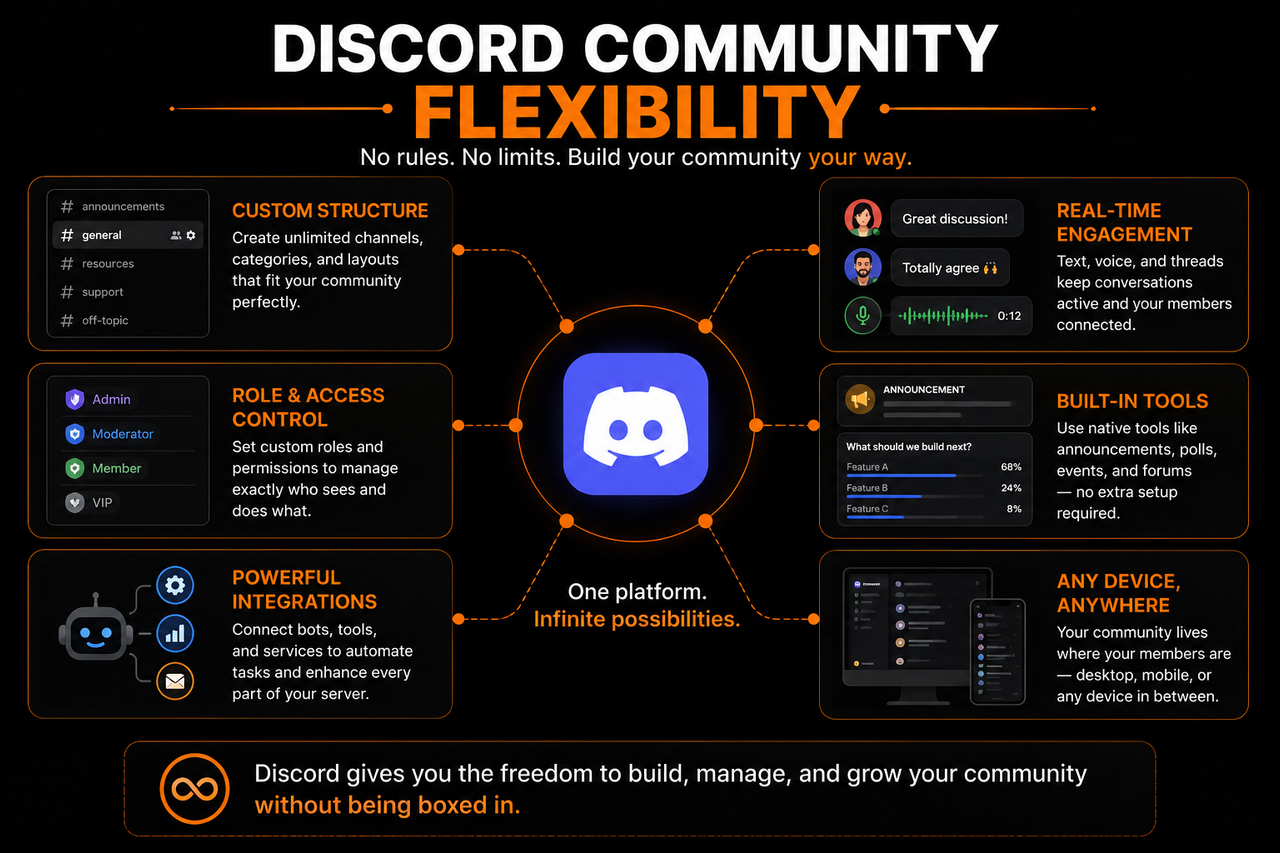
One of the biggest reasons Discord continues to dominate the paid community space is flexibility. While newer platforms often focus on simplicity, Discord focuses on adaptability. That distinction becomes increasingly important as communities grow. A brand-new community with twenty members can operate almost anywhere. A community with hundreds or thousands of members often has very different requirements.
- Different member groups.
- Different access levels.
- Different products.
- Different programs.
- Different workflows.
As complexity increases, flexibility becomes more valuable. This is where Discord begins separating itself from many alternatives. The platform allows community owners to shape the experience around their business rather than forcing the business to fit a predefined structure. For some creators, that flexibility feels unnecessary. For others, it becomes the reason they stay on Discord for years.
Every Community Is Different
One of the challenges with community software is that no two communities operate exactly the same way. A trading community behaves differently than a coaching community. A SaaS community behaves differently than a creator community. A networking community behaves differently than an educational membership. The problem with rigid platforms is that they often assume communities should operate in a particular way.
Discord doesn't make many assumptions. Instead, it provides building blocks.
- Channels.
- Roles.
- Permissions.
- Categories.
- Events.
- Voice rooms.
- Automations.
Community owners decide how those pieces fit together. This freedom allows vastly different communities to thrive on the same platform.
- A trading community might organize channels around market analysis.
- A coaching business might organize channels around client outcomes.
- A creator community might organize channels around content creation and networking.
- A software company might organize channels around product support and customer success.
The platform remains the same. The experience changes entirely. That's the power of flexibility.
Communities Rarely Stay the Same
Another reason flexibility matters is because communities evolve. The structure that works today may not work six months from now. Many creators start with a simple setup.
- A few channels.
- A handful of members.
- Basic discussions.
Everything feels manageable. Then growth happens.
- New members join.
- New products are launched.
- New programs are introduced.
- More conversations occur.
- Different needs emerge.
Suddenly, the original structure no longer works. This is where community owners often encounter limitations with rigid platforms. Making significant changes becomes difficult. Adding new experiences becomes difficult. Expanding the community becomes difficult. Discord handles growth differently.
Because the platform is highly customizable, communities can evolve without completely rebuilding their environment.
- New categories can be introduced.
- New roles can be created.
- New member segments can be added.
- New experiences can be layered onto existing systems.
Growth becomes easier to accommodate.
Member Segmentation Becomes Easier
One of the most valuable aspects of Discord is its role system. At first glance, roles seem simple.
- They control permissions.
- They identify members.
- They provide structure.
In practice, they become incredibly powerful. Community owners can separate members based on:
- Membership level.
- Program enrollment.
- Interests.
- Location.
- Experience level.
- Coaching access.
- Event participation.
This creates opportunities for personalization. Instead of showing every member the exact same experience, communities can create experiences tailored to specific groups. For example, a coaching business might have:
- Free members.
- Paid members.
- Group coaching clients.
- Private coaching clients.
- Alumni members.
Each group can access different resources, discussions, and opportunities. The result is a cleaner experience. Members only see what's relevant to them. As communities grow, this becomes increasingly important.
Automation Changes Everything
Another major advantage of Discord is automation. Many community owners underestimate how much time repetitive tasks consume.
- Welcoming members.
- Assigning access.
- Answering common questions.
- Managing support requests.
- Handling onboarding.
- Moderating discussions.
Individually, these tasks seem small. Collectively, they consume enormous amounts of time. Discord's ecosystem of bots and integrations helps reduce that workload. Many tasks can be automated entirely.
- New members can receive roles automatically.
- Onboarding flows can happen automatically.
- Support tickets can be created automatically.
- Reminders can be delivered automatically.
- Events can be managed automatically.
The result is a more scalable community. Instead of spending hours managing processes manually, community owners can focus on creating value. This becomes particularly important as member counts increase. What works for fifty members rarely works for five thousand.
Automation helps bridge that gap.
Discord Works Well Beyond Membership Communities
One misconception about Discord is that it's only useful for traditional membership communities. In reality, the platform supports a wide range of business models. For example:
- Coaching businesses.
- Mastermind groups.
- SaaS communities.
- Creator memberships.
- Trading communities.
- Agency communities.
- Educational programs.
- Networking groups.
Each of these businesses operates differently. Yet Discord adapts surprisingly well. This flexibility allows creators to experiment. They can launch new programs. Test new ideas. Introduce new experiences. Without needing to migrate to a completely different platform. That adaptability becomes increasingly valuable over time.
Real-Time Interaction Creates Momentum
One area where Discord continues to stand out is real-time interaction. Many community platforms support discussion. Few support live conversation as naturally as Discord. This matters because relationships often form faster through interaction than through content consumption.
A member may watch a course for hours and still feel disconnected from the community. A single conversation can create a meaningful connection almost immediately. Voice channels amplify this effect even further. People can ask questions. Collaborate. Network. Solve problems together. The experience feels more dynamic.
- More human.
- More immediate.
- This doesn't mean every community requires real-time interaction.
Many don't. But for communities that thrive on relationships, Discord offers advantages that are difficult to replicate elsewhere.
Integrations Expand What's Possible
Another reason Discord remains popular is the ecosystem surrounding it. The platform integrates with an enormous number of tools.
- CRM systems.
- Email platforms.
- Automation software.
- Analytics tools.
- Payment platforms.
- Community management solutions.
This allows community owners to build workflows that extend far beyond Discord itself.
For example:
- New purchases can trigger role assignments.
- Member information can sync with CRM systems.
- Support processes can connect with external tools.
- Community activity can inform marketing campaigns.
The result is a community that doesn't operate in isolation.Instead, it becomes part of a larger business ecosystem. For creators building long-term businesses, this flexibility can be extremely valuable.
Flexibility Requires Responsibility
Of course, flexibility isn't automatically a benefit. Poorly used flexibility creates problems.
Many Discord communities become difficult to navigate because owners create too many channels.
- Too many roles.
- Too many permissions.
- Too many systems.
Complexity eventually becomes friction. This is why flexibility should be viewed as an opportunity rather than an excuse. Just because something can be customized doesn't mean it should be.
The best Discord communities often feel surprisingly simple. The complexity exists behind the scenes. Members experience clarity. Not confusion. The goal isn't building the most advanced server possible. The goal is building the most useful experience possible.
The Platform Grows With You
Perhaps the biggest advantage Discord offers is its ability to grow alongside a community. Many creators start small.
- A handful of members.
- A few conversations.
- A simple structure.
As the business evolves, the community evolves too. Discord makes that transition easier than many alternatives. Instead of forcing creators into a predefined framework, it allows the framework to change as needs change. That's one of the reasons so many established communities remain on Discord despite having access to countless alternatives.
The platform provides room to grow, and for communities with long-term ambitions, that's often one of the most valuable features of all.
Picking the Right Home
After comparing Discord, Skool, and Circle, many community owners still find themselves asking the same question.
Which one should I choose?
The answer depends less on the platform itself and more on the type of experience you're trying to create. This is why there isn't a universal winner. The best platform for a course creator may be the wrong platform for a networking community. The best platform for a coaching business may be completely different from the best platform for a SaaS company.
Rather than searching for the perfect platform, focus on finding the best fit. The more closely the platform aligns with your community goals, the easier everything becomes. Member onboarding feels smoother. Engagement feels more natural. Growth becomes easier to manage. Retention improves because the platform supports the behaviors you're trying to encourage.
The challenge is understanding what those behaviors are before making a decision.
Choose Discord If Community Comes First
Discord is often the strongest choice when interaction is the primary source of value. If members are joining because they want conversations, networking, relationships, accountability, or collaboration, Discord becomes difficult to ignore. The platform was built around communication. Everything about the experience encourages participation.
- Members can jump into discussions.
- Join voice calls.
- Network with one another.
- Ask questions.
- Receive immediate feedback.
- Build relationships naturally.
This makes Discord particularly effective for communities where member-to-member interaction is important.
Examples include:
- Networking communities.
- Entrepreneurship communities.
- Agency communities.
- Trading communities.
- Creator communities.
- Coaching communities.
- Mastermind groups.
These communities often thrive because of the people inside them.The content matters, but the relationships matter more.
Discord supports those relationships exceptionally well. It's also a strong choice for community owners who want flexibility.
If you anticipate creating multiple membership tiers, specialized groups, custom onboarding experiences, automation systems, or advanced workflows, Discord provides the room to do so. The tradeoff is complexity.
Discord requires more setup. More planning. More organization. Community owners who invest the time are often rewarded with a highly customizable environment. Those looking for simplicity may prefer something else.
Choose Skool If Simplicity Comes First
Some creators don't want endless customization. They don't want dozens of channels. They don't want to configure permissions. They don't want to manage bots. They simply want a straightforward place where members can learn, participate, and make progress.
This is where Skool shines.
The platform reduces the number of decisions community owners need to make. Everything feels focused. Structured. Predictable. For educational communities, this simplicity can be a significant advantage. Members understand where to go. Content is easy to find. Discussions are easy to navigate. Progress feels clear.
This makes Skool particularly appealing for:
- Course creators.
- Educational memberships.
- Training programs.
- Coaching programs with heavy content delivery.
- Knowledge-focused communities.
The platform works best when content consumption plays a major role in the member experience. If your primary objective is helping members move through educational material, Skool provides a strong foundation.
The tradeoff is flexibility.
What makes the platform simple also limits customization. For many creators, that's perfectly acceptable. For others, those limitations become more noticeable as the community evolves.
Choose Circle If Structure Matters Most
Circle appeals to creators who want a balance between community and organization. The platform feels polished. Professional. Intentional. It often appeals to brands that want a more curated experience.
Members can participate in discussions without feeling overwhelmed by the speed of real-time chat. Content remains organized. Resources remain accessible. Discussions remain easy to follow. This creates an experience that many professionals appreciate. Particularly those who don't want to monitor active conversations throughout the day.
Circle is often a strong fit for:
- Professional communities.
- Creator brands.
- Membership businesses.
- Business networks.
- Industry communities.
- Content-driven memberships.
The platform prioritizes structure without eliminating community interaction. For some audiences, that's an ideal balance. For others, it may feel less dynamic than Discord. Again, neither approach is inherently better. They're simply optimized for different outcomes.
Don't Choose Based on Trends
One mistake community owners frequently make is chasing trends. A creator launches on Skool. Everyone suddenly wants Skool. A major community grows on Circle. Everyone starts considering Circle. A successful membership thrives on Discord. Everyone rushes toward Discord.
The problem with this approach is that you're evaluating someone else's business rather than your own.
What works for one creator may not work for another. Different audiences behave differently. Different businesses deliver value differently. Different communities require different experiences. The goal isn't copying successful communities. The goal is understanding why they're successful.
Once you understand that, platform selection becomes much easier.
Your Community Experience Matters More Than Your Software
One of the most important lessons community owners learn is that software has limitations. No platform can compensate for a weak community experience. Poor onboarding remains poor onboarding. Weak engagement remains weak engagement. Lack of leadership remains lack of leadership.
Software can support great communities. It cannot create them.
This is why some communities thrive on platforms that others criticize. The leadership is strong. The culture is healthy. The value is clear. Members enjoy participating. Those factors matter far more than most feature comparisons.
A community with strong leadership and meaningful value will often outperform a community with better software but weaker execution. That's why platform selection should be viewed as an important decision rather than the most important decision.
The Best Platform Is the One Your Members Will Actually Use
Community owners sometimes become obsessed with features. Members rarely do. Members care about outcomes.
- Can they learn?
- Can they connect?
- Can they get help?
- Can they make progress?
- Can they achieve the goal that caused them to join?
If the answer is yes, the platform is doing its job. The best community platform isn't necessarily the one with the most features. It's the one that helps members achieve results with the least amount of friction. That's the standard every platform should be measured against.
Final Thoughts
Discord, Skool, and Circle are all capable of supporting successful paid communities. The difference is how they approach community building.
Discord prioritizes interaction and flexibility. Skool prioritizes simplicity and learning. Circle prioritizes structure and organization.
Each platform has strengths. Each platform has tradeoffs. The right choice depends on your goals, your audience, and the type of experience you want to create.
- If your community thrives on conversations, networking, and real-time engagement, Discord will likely feel like the strongest option.
- If your community revolves around education and simplicity, Skool may be a better fit.
- If you want a polished and structured environment that balances content and discussion, Circle may be the answer.
Ultimately, successful communities aren't built because somebody chose the perfect software. They're built because somebody created an experience worth being part of. The platform supports that experience.
It doesn't replace it.
Choose the platform that aligns with your members. Focus on delivering value. Build meaningful relationships. Create an environment people enjoy returning to. Do those things consistently, and your community will have a far better chance of succeeding regardless of which platform you choose.