How a Discord CRM Actually Works
Running a Discord community often starts simple.
A few channels. A handful of roles. New members arrive, introduce themselves, ask questions, and gradually find their place. When the community is small, keeping track of people does not feel particularly difficult. You recognize usernames. You remember who joined recently. You know who asked about the paid membership last week and who needs a follow-up.
Then the community grows.
Ten new members become fifty. Fifty become hundreds. Conversations happen across different channels at different times. Someone joins, reads a few messages, and disappears. Another member asks about upgrading but never follows through. Someone else has been active for months but you barely know why they joined in the first place.
The problem is not necessarily that the community needs more activity. It is that the people running it can no longer keep track of every individual member.
That is where a Discord CRM comes in.
A Discord CRM helps community owners understand and manage the people inside their server. Instead of treating Discord as one large stream of usernames and messages, it creates a clearer picture of individual members: who they are, why they joined, what they have done, where they are in their journey, and when they might need attention.
It brings something traditional community management often lacks: continuity.
A member can join on Monday, have a conversation on Tuesday, disappear for a week, and return the following Wednesday. Without a system keeping track of that journey, each interaction can feel like starting from zero.
A Discord CRM helps connect those moments.
And importantly, this is not about turning your Discord server into a cold sales database. Paid communities are built on relationships. The point of tracking members is not to bombard them with messages or push everyone toward an upgrade.
The point is to make sure people do not quietly fall through the cracks.
What a Discord CRM Is
CRM stands for customer relationship management.
The term usually brings to mind traditional businesses keeping track of prospects, customers, conversations, and follow-ups. But the basic idea is much simpler than the software category surrounding it.
A CRM helps you remember the relationship.
For a paid community, that relationship begins long before someone becomes a paying member.
Someone might discover your community through a YouTube video, recommendation, social post, free resource, or another member. They join your Discord server because something caught their attention.
But joining is only the beginning.
They still need to understand what the community offers. They need to know where to go. They may need to ask questions. They need reasons to participate. And if you offer both free and paid access, they need enough context to understand whether the paid membership is actually useful for them.
That creates a journey:
New member → welcomed member → engaged member → paying member → long-term member
Not everyone follows that path perfectly. Some people move quickly. Others spend weeks observing before they participate. Some join, disappear, and return later.
A Discord CRM helps you keep track of those individual journeys rather than seeing everyone as another number in the server member count.
Discord Was Built for Conversation, Not Relationship Tracking
Discord is extremely good at what it was designed to do. It gives communities channels, threads, roles, voice rooms, direct messages, events, permissions, bots, and countless ways for people to interact.
But Discord primarily shows you what is happening now.
Open a channel and you can see the current conversation. Check a member's roles and you can understand some of their access. Look through messages and you might be able to piece together what someone has been doing.
What is much harder is answering questions like:
- Why did this person join?
- When were they last meaningfully engaged?
- Have we already welcomed them?
- Did they ask about the paid membership?
- What were they interested in?
- Have they gone quiet?
- Does someone on the team need to check in with them?
That information may technically exist somewhere.
The problem is that it is scattered.
One piece might be buried in an introduction from three weeks ago. Another might be in a private conversation. Their membership status might live somewhere else entirely. Their recent activity might require manually checking their messages.
The larger the community becomes, the less realistic it is to reconstruct that story for every member. A Discord CRM creates a layer around those conversations so the community team can understand the person behind the username.
A Member Profile Instead of Just a Username
Imagine two people join your server today. Discord tells you that both members joined. From the server's perspective, they can initially look almost identical. But one joined because they watched several of your videos and are already considering the paid membership. The other found a free resource through a friend and wants to look around before deciding whether the community is relevant.
Those people should not necessarily receive the same experience. This is why good member onboarding starts by understanding the person rather than immediately throwing information at them.
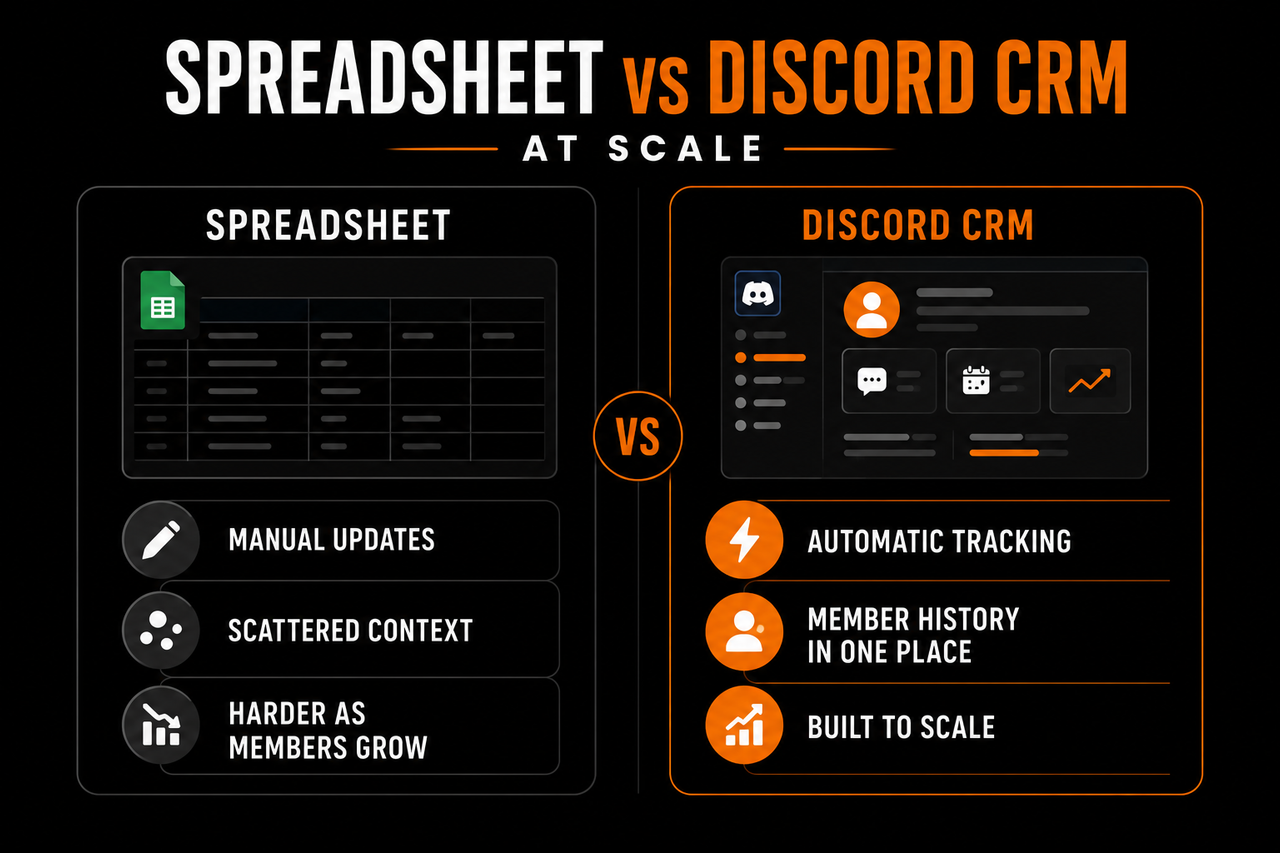
A Discord CRM can build a member profile around those early interactions. Instead of seeing:
Alex123 — Joined today
you begin building context:
Alex123 — Joined today
Interested in improving their current business
Found the community through YouTube
New to the topic
Has completed onboarding
Free member
That context changes how you interact with Alex. When they ask a question later, you already know where they are coming from. When they return after a few days, the conversation does not need to restart from the beginning.
The community remembers them.
That is the real purpose of a Discord CRM. It turns disconnected interactions into an ongoing member relationship.
A Discord CRM Is Not Just an Analytics Dashboard
It is easy to confuse a Discord CRM with community analytics. They overlap, but they answer different questions. Analytics might tell you:
243 members were active this week.
A CRM helps you ask:
Which members were active, and what has happened with them?
Analytics might show that engagement declined. A CRM can help reveal which people have gone quiet and where those members were in their journey when activity stopped. One gives you the health of the crowd. The other gives you context about the people inside it. Both are useful, but they solve different problems.
For a community owner, knowing that engagement fell by 12% might tell you something needs attention. Knowing that dozens of recently joined members stopped interacting after their first few days gives you somewhere to start.
That distinction becomes especially important in paid communities because a member's experience does not happen entirely in public channels. Someone can read messages every day without posting. Someone can have one useful private conversation and decide to upgrade. Someone can post constantly while having no interest in becoming a paid member.
Raw activity alone does not tell the whole story.
The Goal Is Better Community Management
There is an important line between tracking members and treating members like entries in a database. A good Discord CRM should help you cross that line in the right direction. The objective is not to collect as much information as possible. It is to preserve useful context so you can provide a better experience.
Think about a local business where the owner recognizes regular customers. They remember what someone usually orders. They remember a conversation from the previous week. They ask how something went because they genuinely remember discussing it. That familiarity makes the experience feel personal.
Small Discord communities naturally work like this. The owner recognizes almost everyone because there are not enough members for relationships to become difficult to remember. Growth changes that.
A Discord CRM helps a larger community preserve some of the attentiveness that normally disappears as membership increases. Instead of relying entirely on someone's memory, the context surrounding each member remains available.The technology should support the relationship, not replace it.
How a Discord CRM Tracks Members
Knowing what a Discord CRM is only matters if you understand what it actually keeps track of.
The goal is not to record every message a member sends or turn every interaction into another data point. A useful Discord CRM focuses on the information that helps you understand the member's relationship with the community and how that relationship changes over time.
That starts from the moment someone joins.
A new member entering your server may look like another username in the member list, but their arrival is the beginning of a journey. They might have discovered the community through your content, joined through a friend's recommendation, arrived specifically to access a free resource, or already be interested in becoming a paying member.
Discord can tell you that they joined.
A CRM helps you remember everything useful that happens afterward.
Start With What You Learn During Onboarding
Onboarding is one of the earliest opportunities to learn something meaningful about a member.
You already need to help them understand where they are, what the community offers, and what they should do first. Rather than making that process entirely one-sided, you can also use it to understand why they decided to join.
That does not mean greeting someone with a questionnaire.
A few relevant questions can reveal plenty.
You might learn what they are trying to accomplish, what they currently need help with, how they discovered the community, or which part of the community interested them enough to join.
Imagine three people enter the same business community.
- The first is trying to land their first client.
- The second already runs an agency and wants to improve lead generation.
- The third is doing well professionally but joined because they want to meet other business owners.
They entered through the same Discord invite, but they are not looking for the same experience.
That information immediately gives the community context.
The first member may benefit from beginner resources and conversations around getting started. The second probably needs something more advanced. The third might get the most value from events and introductions to other members.
Without tracking, those details can easily disappear once onboarding ends. With a Discord CRM, the useful information gathered during that first conversation can remain attached to the member as their journey continues. This also makes onboarding more valuable beyond simply helping someone enter the server. You are establishing the starting point from which future interactions can be understood.
Track the Actions That Actually Matter
Once someone is inside the community, there are countless actions you could technically track.
- Messages sent.
- Channels visited.
- Reactions added.
- Events attended.
- Roles received.
- Threads created.
- Questions asked.
- Days active.
The fact that something can be tracked does not mean it needs to be. Collecting everything creates noise. A CRM becomes useful when it highlights the actions that tell you something meaningful about the member journey.
For one community, attending a live event might be a strong sign of engagement. For another, it could be completing onboarding and participating in a particular discussion. A community built around education might care about whether members are using learning resources, while a networking community may care more about whether members are forming connections with one another.
The actions worth tracking depend on what members are supposed to get from the community. Some useful moments could include:
- Completing onboarding.
- Participating in an important discussion.
- Attending a community event.
- Showing interest in the paid membership.
- Becoming a paying member.
- Becoming noticeably less active.
- Returning after a period of inactivity.
Each tells you something different. Completing onboarding tells you that the member has taken the first step.Participating tells you they are beginning to involve themselves. Showing interest in paid access tells you they may see enough value to want more.
Becoming quiet tells you something may have changed. Returning tells you the relationship was not necessarily lost just because the member disappeared for a while. These moments are much more useful than simply knowing someone has sent 117 messages since joining.The CRM should help you understand progress, not drown you in activity.
Activity Needs Context
A member being active does not automatically mean they are engaged. Someone can join a server, send dozens of messages during their first few days, and disappear the following week. Another member might only participate a few times each week but continue doing so for months.
If you judge them using message volume alone, the first member looks more engaged. If you look at their behavior over time, the second member has built a much stronger relationship with the community.
This is where tracking becomes valuable.
You are not only looking at what someone did. You are looking at whether their behavior is changing. Suppose a paying member normally participates several times each week, regularly attends events, and occasionally asks questions. They suddenly stop appearing for two weeks. That inactivity matters because it is unusual for them.
Now take another paying member who rarely posts but consistently attends one monthly call and uses the resources available to them. Two weeks without a public message may mean absolutely nothing. Both members could appear inactive if your only measurement is recent messages.
Their history tells you otherwise.
The same principle applies to free members. Someone who has never participated may simply prefer observing. Someone who used to participate every day and suddenly stops has experienced a change. A Discord CRM gives you enough history to tell the difference.That matters because your response should be different too.
Understand Where Members Are in Their Journey
As member information begins accumulating, it becomes useful to understand where each person currently sits in their relationship with the community. This does not need to become an elaborate sales pipeline with dozens of stages.A simple journey might look like:
New member → Onboarded → Engaged → Interested in paid → Paying member → Long-term member
There may also be members who become quiet at any point along that journey. These stages are not rules that every member needs to follow in order. Someone who already knows your work might join and upgrade almost immediately. Someone else may remain an active free member for months before considering the paid membership. Another person may love participating in the free community without ever wanting to pay.
The purpose of tracking the stage is not to force people toward the next one. It is to understand the relationship that currently exists. That prevents every member from being treated the same way.
A person who joined yesterday probably needs help finding their footing. A member who has participated for three months and recently asked about paid access already understands the community.
A paying member who has been around for a year needs neither an introduction nor a sales pitch. Their experience should focus on continuing to receive value from the membership they already have.Knowing the stage gives the rest of the member's activity context.
Conversations Add Information Activity Cannot
Some of the most important things you learn about members will never appear in an activity metric.
They come from conversations. A member might tell you they are launching a business next month. Someone might explain that they are struggling with a particular problem. Another person might say they are interested in the paid membership but cannot afford it right now. Someone else might tell you they joined specifically because they wanted accountability.
Those details can influence future interactions far more than knowing how many messages the member sent this week. Imagine someone tells you:
I'm trying to get my first few clients before I spend money on another membership.
A month later, you speak with them again. Without that previous context, you may ask whether they are ready to upgrade. With context, you can ask how finding those first clients has been going. The conversation continues naturally because the community remembers where it left off.
If they are still not in a position to buy, you can offer something useful for free instead. Point them toward a resource, discussion, event, or member who may help them with the problem they originally mentioned.
That small gesture matters.
Rather than making the member feel like every conversation exists to convert them, you show that being useful comes first. And if their situation changes later, the relationship already exists.
Shared Context Matters When You Have a Team
Tracking becomes even more valuable when the owner is no longer the only person managing the community.
A growing Discord server may eventually involve moderators, community managers, coaches, support staff, or people responsible for speaking with potential customers. A member may interact with several of them. Without shared context, every team member only knows the conversations they personally participated in.
One person knows why the member joined. Another knows they were interested in upgrading. Someone else helped them with a problem last week. If that information stays isolated, the member can end up repeating themselves.Worse, they can receive communication that ignores what they have already said.
Imagine a member explains that they cannot purchase the paid membership until next month. Three days later, another person from the team messages them asking whether they are ready to upgrade. A week later, someone else does the same. The problem is no longer a lack of follow-up.It is too much follow-up without context.
A CRM creates a shared view of the relationship so the team can continue from what has already happened rather than restarting the conversation every time someone new gets involved.
That becomes increasingly important as the community grows because maintaining a personal experience becomes harder when responsibility is spread across several people.
Tracking Should Show You Where Attention Is Needed
The real value of all this information appears when it helps you notice members who might otherwise be missed. A new member who never completes onboarding may need help getting started. A previously active member who suddenly becomes quiet may be drifting away. A free member who has shown repeated interest in paid access may have questions that are preventing them from making a decision. A paying member who stops participating may no longer be receiving enough value to justify staying.
These are very different situations.
Without member tracking, they can all disappear into a growing server. With a CRM, changes in the member journey become easier to spot. That does not mean every change should trigger an automated message.
Tracking should tell you where attention may be useful, not automatically decide what should happen next.
Sometimes a personal message makes sense. Sometimes sharing a resource makes sense. Sometimes inviting someone to an upcoming event is enough. Sometimes the member does not need anything at all.
The CRM provides the context required to make that decision. This is where tracking stops being about data and starts becoming useful for the community itself.
You know who joined. You know what they came for.You know how their relationship with the community has developed. You know when something changes. The next challenge is deciding what to do with that information.
Because recognizing that a member needs attention is only valuable when you can respond in a way that strengthens the relationship rather than making them feel tracked, pressured, or sold to.
That is where member nurturing begins.
Nurturing Members Behind the Scenes
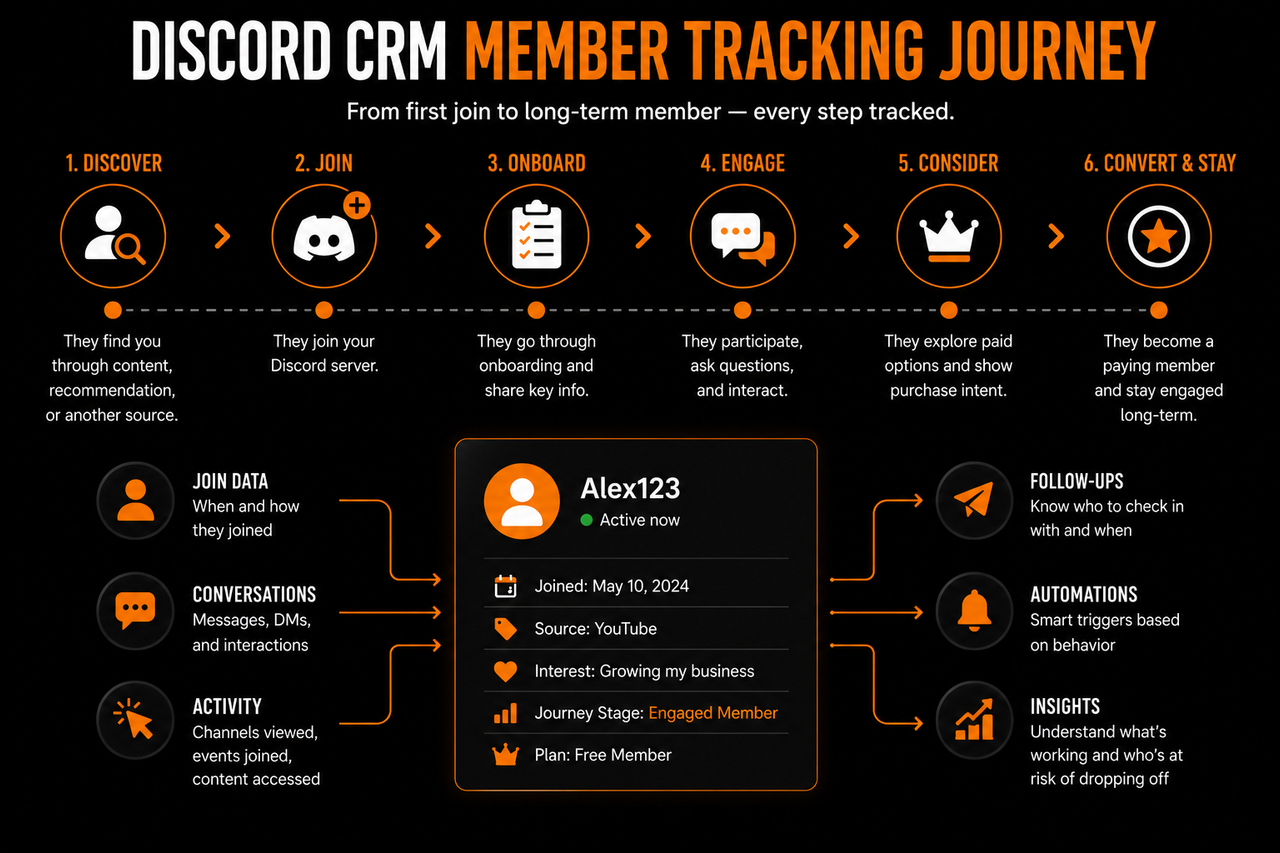
Tracking members gives you context. Nurturing is what you do with it.
The purpose is not to create a system that constantly looks for opportunities to sell. It is to make sure members receive attention when it is useful, especially at moments when they might otherwise lose interest, become confused, or quietly disappear.
This is where the information stored in a Discord CRM becomes practical.
If you know why someone joined, what they are interested in, how they have interacted with the community, and what previous conversations have taken place, you can communicate with them based on their actual situation instead of sending the same message to everyone.
Follow Up With a Reason
Follow-up works best when there is a reason behind it.
If a member mentioned that they were struggling with something, checking back on their progress makes sense. If they showed interest in an upcoming event, reminding them when it is approaching can be useful. If someone who normally participates regularly suddenly disappears, asking how things are going may be appropriate.
Compare that with repeatedly messaging someone simply because they have not purchased yet. The difference is intent. A message such as:
Hey, are you still interested in upgrading?
does not provide much value by itself. But if the member previously told you they were struggling to find clients, you could instead reach out when something relevant appears in the community:
You mentioned you were working on getting your first few clients. We just had a useful discussion around outreach, so I thought I'd point you toward it.
Now the interaction has a purpose even if the member never buys anything. That is what nurturing should feel like from their side. Helpful first. Commercial when relevant.
Not Every Interested Member Is Ready to Buy
When someone shows interest in a paid membership but does not purchase, it is easy to assume the price is the problem. Sometimes it is. Often, the bigger issue is that the member has not yet understood enough of the value to justify paying for it. They may know what the membership includes without understanding what those things will actually do for them. A list of private channels, weekly calls, resources, and exclusive content describes the membership. It does not necessarily explain why the membership matters.
Good nurturing helps connect the value of the paid experience to what the member is already trying to achieve. If they joined for accountability, show how the paid experience provides accountability. If they need direct support, explain where that support exists. If they want to meet people at a similar level, help them understand how the paid community creates those connections.The conversation becomes about their outcome rather than your feature list. And when the member genuinely cannot purchase right now, continuing to push rarely helps.
Give them something useful instead.
That could be a free resource, an answer to their question, access to a relevant public discussion, or an invitation to an event available to free members. You are still giving them a reason to remain connected to the community. When their circumstances change, they are much more likely to remember a community that helped them without demanding a purchase in return.
Promotions Can Support the Journey
Limited-time promotions can also play a role in nurturing, particularly for members who already understand the value but have been reluctant to make the decision. A temporary discount, bonus, special event, or limited offer can create a reason to act now rather than continuing to delay. But a promotion works best when interest already exists. It should help an interested member make a decision, not become the entire reason they are interested.
If someone does not understand why the membership is useful to them, reducing the price does not solve the underlying problem. This is another area where a Discord CRM helps.
Instead of broadcasting the same promotion repeatedly to everyone, you have context around who has previously shown interest and who has not. That makes promotion more relevant and reduces the need to pressure the entire community whenever you want to increase conversions.
Nurturing Does Not End at Conversion
A member purchasing the paid membership should not cause the relationship tracking to stop. If anything, the next stage matters even more. They have now paid for an experience and expect the value that convinced them to join. A CRM can help you notice whether that is actually happening.
- Did they complete paid-member onboarding?
- Have they participated in the areas they now have access to?
- Have they attended the events they were interested in?
- Are they still engaged a month after upgrading?
Someone paying once does not automatically mean the community succeeded. A member who upgrades and then disappears may eventually wonder why they are continuing to pay for something they barely use.
That is why nurturing should continue throughout the membership. The focus simply changes.Before conversion, you are helping someone understand and experience the value of the community. After conversion, you are helping them continue receiving the value they paid for.
A Discord CRM makes both easier because the member's history does not disappear when their role changes from free to paid.
The relationship continues.
The System Should Stay Behind the Scenes
Ideally, members should never feel like they are moving through a CRM. They should not feel categorized, monitored, or pushed from one stage to another. They should simply experience a community that remembers them. Someone follows up on a problem they mentioned. A relevant resource appears when they need it. A quiet member receives a thoughtful check-in. A paying member is not forgotten after the transaction.
The systems behind those interactions can be sophisticated, but the experience in front of the member should remain human. That is the balance a Discord CRM is meant to create.
It gives community owners enough structure to manage relationships at scale without making those relationships feel like they are being managed by a spreadsheet.
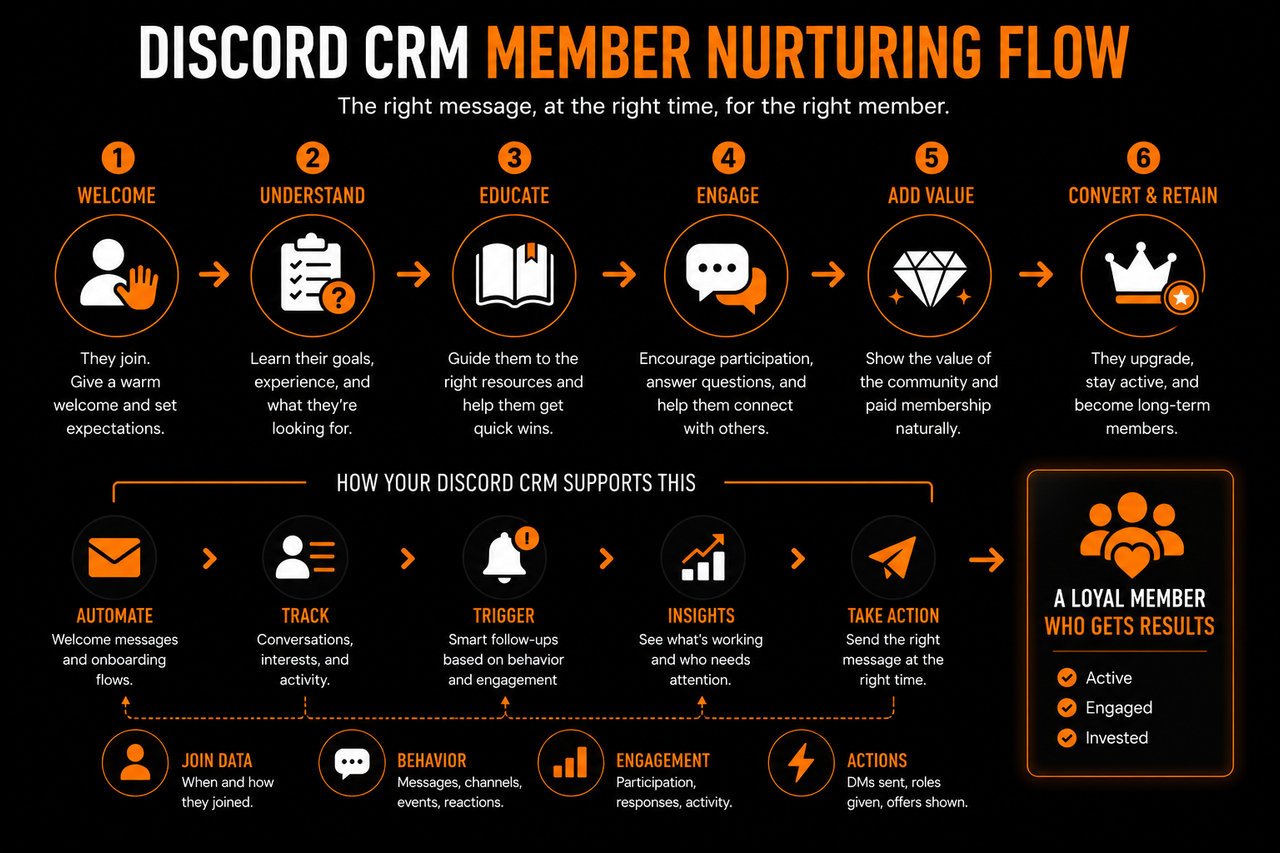
And that becomes especially important as the server grows, because eventually the alternative is exactly that: trying to remember hundreds of member journeys manually or keeping them scattered across spreadsheets that were never designed to manage an active community.
Why a Spreadsheet Doesn't Scale
When a Discord community is small, a spreadsheet can seem like a perfectly reasonable way to keep track of members.
You create a few columns for usernames, join dates, membership status, interests, and notes. Maybe you add another column for the last time someone was contacted. With a few dozen members, the system can work because the amount of information being managed is still small enough to handle manually.
The problem appears as the community grows.
Every new member creates another row to maintain. Every meaningful conversation creates information someone needs to remember to add. Membership changes need updating. Follow-ups need recording. Inactive members need identifying. If multiple people manage the community, everyone needs to keep the same document accurate.
The spreadsheet does not necessarily become unusable. It becomes increasingly dependent on people remembering to maintain it.
Manual Tracking Creates Gaps
Imagine a member joins and tells the community manager that they are interested in the paid membership but want to wait until next month. That information is useful.
Someone now needs to open the spreadsheet, find the member, record what happened, and potentially create a reminder to follow up later. If they forget, the conversation remains in Discord and the spreadsheet never knows it happened.
Multiply that across hundreds of members and dozens of daily interactions.
The problem is not that the team does not care about members. There are simply too many small updates happening for manual tracking to remain reliable. Eventually, gaps appear.
A member's status is outdated. A conversation was never recorded. Someone who became inactive was never noticed. Another member receives a follow-up even though someone else from the team already spoke with them. The spreadsheet is only as current as the last person who updated it.
A Discord CRM can reduce that dependency by connecting member information more closely with what is actually happening inside the community.
Growth Creates More Relationships, Not Just More Rows
It is easy to think scaling a community simply means managing a larger member list. The real challenge is managing more relationships. One hundred members do not just represent one hundred usernames. They represent different reasons for joining, different levels of engagement, different conversations, different membership statuses, and different points in the member journey. At five hundred or one thousand members, trying to maintain that context manually becomes increasingly difficult.
Even if the spreadsheet contains every member, finding the people who currently need attention becomes another task entirely.You may have hundreds of rows of accurate information while still needing to manually determine:
- Who joined recently but never completed onboarding?
- Who used to participate but has gone quiet?
- Who expressed interest in becoming a paying member?
- Which paying members are becoming disengaged?
- Who has already been contacted by someone on the team?
A spreadsheet stores information well. It does not naturally turn ongoing community activity into a member journey. That distinction becomes more important as the server grows.
A CRM Creates a Living Member Record
The advantage of a Discord CRM is not simply having a more advanced place to store names and notes. It is having member records that develop alongside the community.
A member joins.Their onboarding adds context. Their activity adds more. Conversations reveal what they care about. Their membership status changes. Periods of inactivity become noticeable. Future interactions build on everything that happened before. Instead of repeatedly reconstructing the member's story from Discord messages, spreadsheets, and memory, the useful context remains connected.
That gives the community owner something spreadsheets struggle to provide at scale: a current view of the relationship. And that is ultimately what a Discord CRM is supposed to accomplish.
- It does not replace conversations.
- It does not replace community managers.
- It does not replace the owner being present and actually knowing the people inside the community.
It gives those people a better system for remembering what would otherwise be lost as the community becomes larger. A small community can rely heavily on memory because the owner may genuinely recognize almost everyone. A growing community cannot assume that will continue forever. More members create more conversations, more opportunities, more people going quiet, and more moments where the right interaction could make a difference. The systems behind the community need to grow with it.
A Discord CRM provides that structure without requiring the member experience itself to become impersonal.
- The member still sees a Discord community.
- They still talk to people.
- They still join conversations, attend events, ask questions, and build relationships.
Behind the scenes, the community has a clearer understanding of who those members are and where they are in their journey. That is how a Discord CRM actually works. Not as a replacement for community building, but as the layer that helps you keep doing it personally when remembering every member yourself is no longer realistic.