

How to Re-Engage Inactive Members
Every paid community, no matter how healthy it looks from the outside, has a quiet majority. These are the members who joined, maybe even paid, and then simply stopped showing up. No complaint, no cancellation, no dramatic exit. Just a slow fade into the background, easy to overlook because there's always something louder demanding an admin's attention.
Treating those members as a lost cause is one of the more expensive mistakes a growing community makes. Most inactive members aren't gone for good. They're waiting for a reason to come back that hasn't reached them yet.
Why Members Go Inactive
Understanding why someone went quiet changes how you bring them back, so it's worth spending real time here before jumping straight to tactics.
The mundane reasons are the most common ones
Inactivity almost never means someone came to hate your community. Far more often, life simply got busy and Discord was the first notification muted when things got hectic. Or the value they originally came for got buried under a dozen channels they never quite figured out how to navigate. Both of these are structural, not emotional, which is exactly why a small, well-placed nudge tends to work as well as it does.
The awkwardness of returning is real, and underestimated
There's a subtler reason worth naming: some members who've been quiet for a while feel genuinely awkward about jumping back into a conversation that's clearly moved on without them. That hesitation keeps people away even when they'd genuinely like to return, and it's a barrier a good re-engagement message can specifically address by making the return feel low-stakes rather than like walking back into a room mid-conversation.
Platform and structure play a role too
Sometimes the honest answer is that the community itself made staying active harder than it needed to be, too many channels, an unclear structure, or a genuinely confusing first-week experience that never quite resolved. If a meaningful share of your inactive members went quiet within their first month, it's worth checking whether the real fix belongs upstream, in onboarding, rather than in a win-back message after the fact.
A quick way to diagnose which reason applies
Before writing a single re-engagement message, it helps to bucket your inactive members by roughly when they went quiet relative to when they joined. Members who went inactive within their first two weeks are usually telling you something about onboarding, not about their long-term interest. Members who were active and engaged for months before going quiet are more likely dealing with a genuine life circumstance shift. And members who churned in waves around a specific point in time, say, right after a format change or a period of low activity from the admin team, are pointing at something structural worth investigating directly rather than fixing one at a time through outreach alone.
Defining and Tracking Inactivity in Practice
Before running any re-engagement effort, it helps to have a clear, consistent definition of "inactive" rather than relying on gut feeling. For most paid Discord communities, a useful working definition is no messages, reactions, or event attendance over a rolling 30-day window, adjusted up or down depending on how active the community is overall. A fast moving daily-discussion server might set the bar lower, since 30 days of silence there is a stronger signal than it would be in a community with a naturally slower weekly rhythm. Discord's own Server Insights, available once a server crosses a member threshold, gives a baseline view of overall activity trends. For finer-grained, per-member tracking, dedicated analytics bots can flag individual members who've crossed an inactivity threshold, which turns "some people have probably gone quiet" into an actual, actionable list. Whatever tool is used, the important part is having some consistent, repeatable way to identify who's inactive, rather than relying on an admin's memory of who they haven't seen posting lately, which reliably misses quieter members who were never loud to begin with.
Re-Engaging Inactive Members the Right Way
Bringing someone back rarely works as a single message. It works as a short, thoughtful sequence, tailored to how long they've actually been gone.
Segment before you send anything
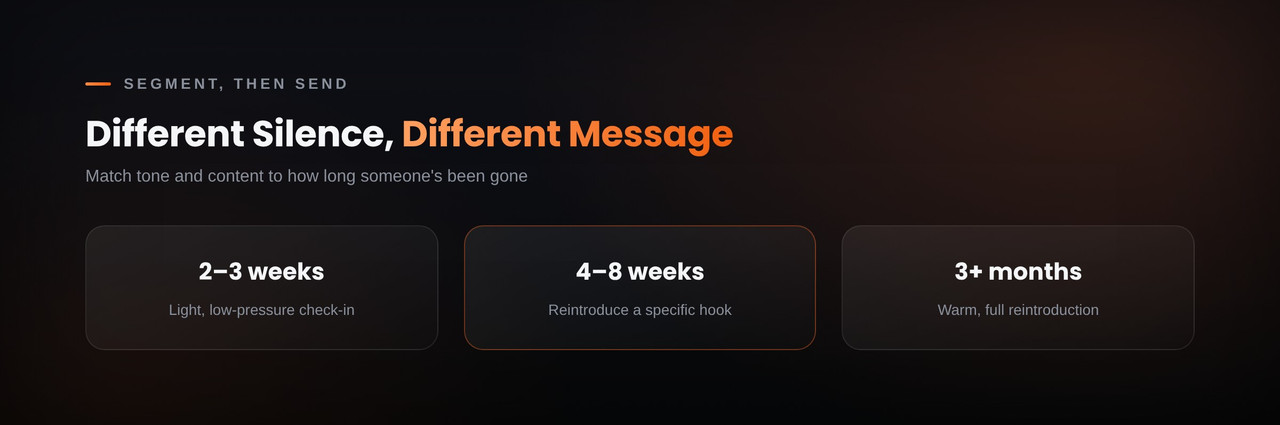
Grouping every inactive member into one bucket and sending them all the identical message wastes the personalization that makes re-engagement work in the first place. Someone who went quiet two weeks ago needs a fundamentally different tone than someone who's been gone three months. Re-engagement research consistently shows that segmenting by how long someone's been inactive, and tailoring messages to that specific window, meaningfully outperforms a one-size-fits-all approach.
A shape that tends to work well
For the recently quiet, a light, low-pressure check-in tends to perform best, something that doesn't assume anything's wrong, just opens the door back up. For members who've been gone longer, a message with more actual substance attached, an update, a genuinely useful resource, a specific.reason to look back in, tends to do more work than a bare nudge, since the original excitement has.had more time to fade. (For the message-by-message breakdown of that first sequence, see how to follow up with members who go quiet.)
What kind of results this actually produces
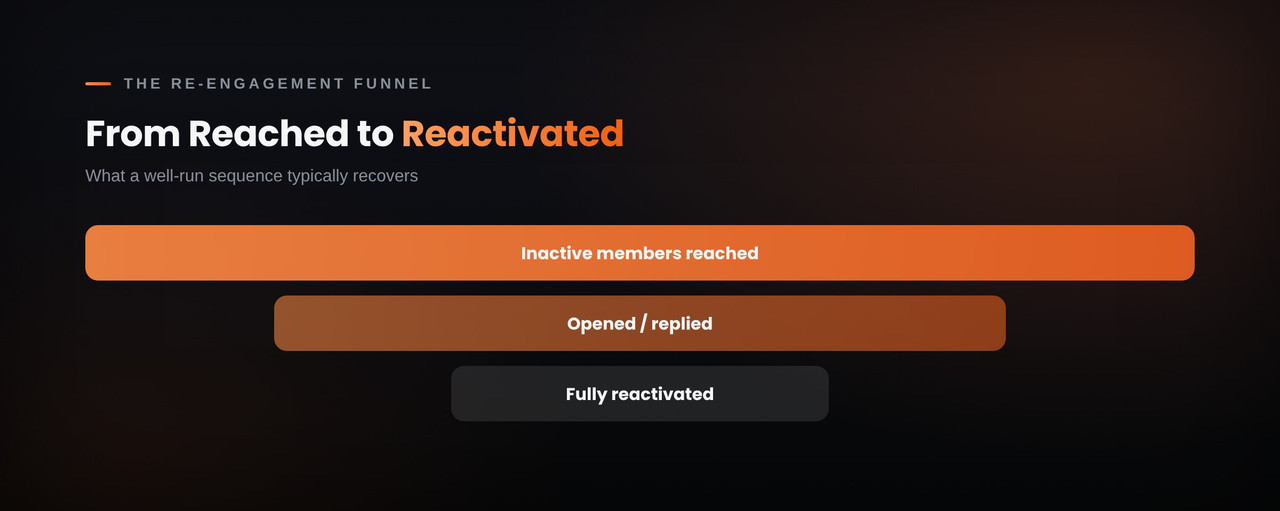
It's worth being realistic about the numbers here, because overpromising leads to abandoning the tactic too early. Well-executed re-engagement sequences typically recover somewhere in the 5% to 15% range of the people they reach. That's not everyone, and it was never going to be. But applied consistently across a large enough inactive base, that range represents a genuinely meaningful chunk of members who would otherwise have simply stayed gone.
Nudges That Work, Spam That Doesn't
The line between a thoughtful nudge and something that reads as spam is thinner than most admins assume, and crossing it does real damage, sometimes pushing a quiet member to mute or leave entirely rather than come back.
Specificity is what separates the two
A generic broadcast, "we miss you, come check out the server," sent to everyone at once reads as automated, because functionally it is. A message that references something specific, why they originally joined, a conversation they were part of, something that's happened since they went quiet, reads as a real check-in, even if it was written once and sent to many people with light personalization.
Give people one clear, easy thing to do
Vague calls to action underperform specific ones by a wide margin. "Come back and see what's new" asks the reader to do the work of figuring out what that even means. "Here's the one thread from this week you'd actually care about" gives them a single, low-effort next step, which is almost always what a re-engagement message needs to succeed.
Respect the fact that they're more sensitive to being chased, not less
Members who've gone quiet are often the fastest to mute a channel or leave a server entirely if a re-engagement attempt feels like pressure rather than an invitation. This is exactly why tone and spacing matter more here than almost anywhere else in community management. One well-placed message beats three pushy ones every time.
Bringing the Quiet Majority Back
Even a modest reactivation rate changes the character of a community in ways that go beyond the raw numbers.
The ripple effect of reactivated members
Bringing back one in ten inactive members doesn't just recover a handful of names on a spreadsheet. Reactivated members often reignite conversations and energy that had gone stale, which benefits the members who never left in the first place too. A community that feels consistently alive is, in a very real sense, built partly on successfully winning back people who'd started to drift. (How to keep members engaged in a community covers what keeps that energy going day to day.)
Why this compounds beyond the individual member
A returning member often does something a brand new member can't: they bring context. They remember earlier conversations, recognize other longtime members, and can jump back into ongoing threads without needing a full reintroduction. That familiarity makes their return feel less like new-member onboarding and more like a natural continuation, which in turn makes it easier for other quiet members watching from the sidelines to feel like coming back is a normal, low-stakes thing to do rather than an awkward reentry.
Treat it as an ongoing rhythm, not a one
time campaign The mistake most communities make is treating re-engagement as a special campaign they run once, usually when the member count starts looking embarrassing, rather than a standing part of how the community operates. Communities that stay healthy over the long run tend to have some version of this running continuously in the background, catching people close to the moment they start to drift rather than months after the fact.
Don't confuse quiet with gone
It's easy to look at a large inactive segment and assume the community has a fundamental problem. Often, it just means a meaningful share of members are in a normal, temporary lull rather than a permanent exit. Treating them as recoverable, and building the systems to actually try, is what separates communities that grow their active base over time from ones that quietly bleed members while celebrating new joins. (For the cancellation stage version of this same idea, see why members cancel, and how to keep them.)
Sample Nudges You Can Adapt
- For someone quiet 2-3 weeks (light, assumes nothing is wrong): "Hey [name], haven't seen you around in a bit, hope things are good. [Specific relevant update] happened recently if you want to catch up, no pressure either way."
- For someone quiet 4-8 weeks (more substance, reintroduce a specific hook): "Hey [name], it's been a little while. Since you were last active, [specific thing tied to their original interest] has come up a few times and made me think of you. Would love to have you back in that conversation whenever works."
- For someone quiet 3+ months (warm reintroduction, low pressure): "Hey [name], it's been a while, hope life's treating you well. Quick reminder of what this community's about, in case it's been a bit fuzzy: [one sentence value reminder]. The door's wide open whenever you want to jump back in."
Each message gets more explanatory the longer the gap, on the assumption that memory of the community's specific value fades with time, while the earliest check-ins can stay light and assume the person remembers exactly what they're being invited back to.
Common Mistakes When Re-Engaging Inactive Members
- Sending one blast to the entire inactive list at once. Beyond feeling impersonal, this treats a member gone two weeks identically to one gone six months, when the right message for each is meaningfully different.
- Leading with what they're missing instead of a genuine check-in. "You're missing out on X" reads as a sales pitch. Leading with real curiosity about how they're doing lands as care instead, and tends to get more genuine replies.
- Running re-engagement only as an occasional special campaign. Communities that treat this as a one-time push, rather than an ongoing rhythm, let new inactive members accumulate untouched for months between campaigns, losing recoverable people simply due to timing.
- Ignoring why a member went quiet in the first place, if it's known. A member who left because of a structural or moderation issue needs that issue acknowledged, not just a generic invitation to return to the same environment that pushed them out.
Quick FAQ
- How long should someone be inactive before I count them as "inactive" for a campaign?
Most re-engagement frameworks use somewhere around 30 days of no meaningful activity as the starting threshold, with distinct messaging for the 30, 60, and 90 day marks as silence continues. Shorter windows risk annoying members who are simply having a quiet week rather than actually drifting.
- Should re-engagement messages come from the community owner personally, or feel automated?
They should feel personal regardless of how they're produced. A message that references specific, real details about that member's history in the community will outperform a generic broadcast even if both were sent through the same automated system.
- Is it worth re-engaging free members, or only paying ones?
Both, and often free members even more urgently. A free member who's gone quiet was likely somewhere in the middle of deciding whether to convert, and losing them silently closes off a conversion that a paying member's cancellation would have made explicit anyway.
- What if someone doesn't respond to any re-engagement attempts?
Let it rest after a genuine final attempt. Continued messaging past that point rarely recovers the relationship and increases the odds they mute or leave outright, which forecloses even the small chance they might return on their own later.
- How do I measure whether my re-engagement effort is actually working?
Track two numbers separately: reply rate (did the message get a response at all) and reactivation rate (did the person actually come back and engage again afterward). A message that gets replies but no lasting reactivation usually means the invitation worked but whatever originally caused the disengagement wasn't addressed, so the person drifts again shortly after.
- Should re-engagement messages ever be sent from a different person than who normally posts announcements?
It can help. A message that clearly comes from a real person, especially if it's someone the member interacted with before going quiet, tends to feel more genuine than one that comes from a generic community or bot account, even when the underlying process is automated.
- Is there a point where a member has been gone too long to bother reaching out?
Rarely, as long as the message is honest about the length of the gap rather than pretending it hasn't been noticed. Even members gone six months or more sometimes respond well to a warm, low-pressure reintroduction, particularly if something genuinely new and relevant has happened since they left.
Further Reading
- Constant Contact's guide to re-engagement emails — segmentation by inactivity length, referenced above
- Omnisend's win-back email benchmarks — realistic reactivation rate ranges
- ActiveCampaign's re-engagement sequence research — timing windows and sequence structure
Segmenting inactive members correctly, and following up with the right tone at the right moment for each one, is a level of ongoing attention most admins simply don't have hours in the week to sustain by hand. But the payoff for the ones who do it consistently is real: a community that feels alive instead of one that's slowly, quietly emptying out while the member counter keeps climbing.