

How to Run a Referral Program for Your Community
Your happiest members are already telling their friends about your community, right now, with no prompting from you. A referral program doesn't invent that behavior out of nowhere, it just gives something that's already happening a little structure and a genuine reason to happen more often. It pairs well with lead magnets to grow a community for the friends who aren't ready to join immediately, since referrals bring the right people to the door and a lead magnet keeps them warm until they are.
Why a Referral Program Beats Ads
There's a reason word of mouth consistently outperforms paid acquisition for community-driven products, and it isn't just a marketing cliche.
Trust is the entire mechanism
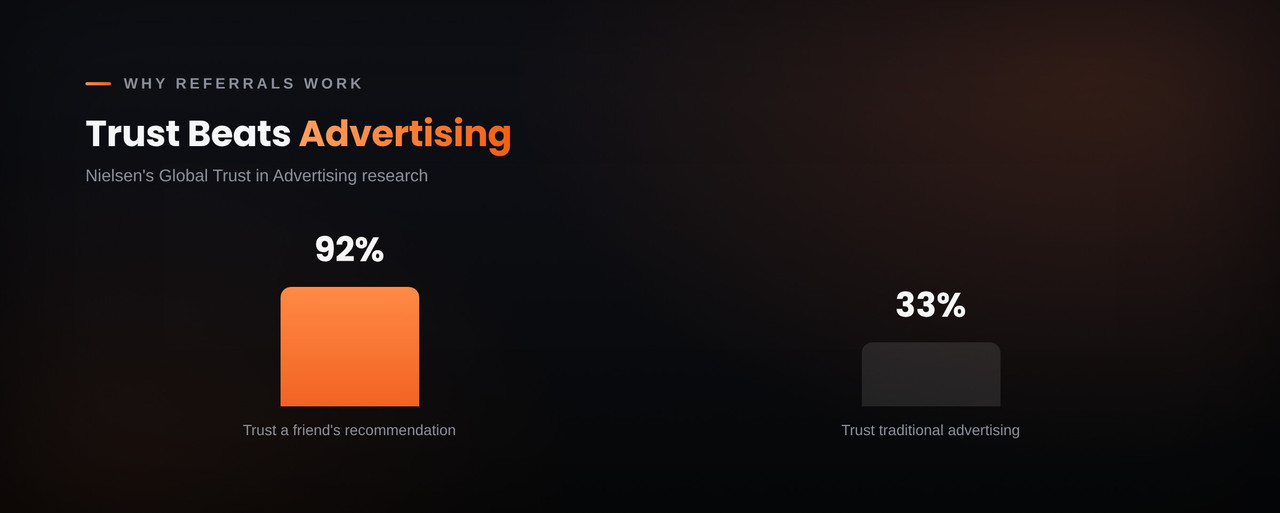
Consumer research is remarkably consistent on this point: [Nielsen's Global Trust in Advertising research (https://referralhero.com/blog/how-to-optimize-referral-program-performance) has repeatedly found that 92% of consumers trust recommendations from friends and family over any other form of advertising, by a wide and durable margin. That trust doesn't just get someone to click a link, it gets them to actually show up with realistic expectations already set by the friend who invited them, which makes the entire onboarding process easier before it's even begun.
Referred members stick around longer
This isn't just a nice theory, it shows up clearly in retention data. Members who arrive through a referral consistently show meaningfully higher retention than members acquired through any other channel, often by a wide margin, ReferralHero's research cites a 37% higher retention rate for referred customers specifically. Separately, peer-reviewed research published in the Journal of Marketing, summarized by Extole, found referred customers to be roughly 16% more valuable and about 18% less likely to churn than customers who weren't referred. That compounding effect, better retention on top of essentially free acquisition, is exactly why referral programs punch so far above their cost.
Why this compounding effect matters so much for a paid community specifically
Every retention benefit compounds twice for a referral-driven member: once because they arrived with realistic expectations already set by a trusted friend, and again because their friend being in the same server gives them a built-in reason to stay engaged even during a quiet week. A member with zero social connection inside a community is far more likely to quietly drift than one who has at least one person they already know checking in occasionally. Referral programs, in effect, are also a retention tool wearing a growth-tool costume.
Discord's own history is the clearest case study available
It's worth returning to this example because it's so directly relevant. Discord itself grew to hundreds of millions of users almost entirely through invite links passed between friends, without a traditional advertising budget behind it in its earliest and most explosive growth years. The platform's founders leaned into this deliberately, making it frictionless to invite a friend into a server with a single link, no account required to click through. Your community doesn't need anything close to that scale to benefit from the exact same underlying mechanic. (For the fuller picture of where members come from beyond referrals, see how to grow a paid Discord community.)
What to Reward and How
Cash isn't usually the right reward inside a Discord community, and it's rarely necessary to get real results. Discord's own culture already has a vocabulary of rewards that work well and cost almost nothing to give out.
Native rewards outperform generic ones
A special role, early access to a channel most members can't see yet, a visible badge, or a private thread reserved for people who've brought in a few members, all of these tap into status and belonging in a way that resonates specifically within a Discord community's culture. These rewards are cheap to provide and, notably, they're often more motivating than a small cash payout would be, because they're visible to the rest of the community in a way money never is.
Tiering the rewards keeps momentum going
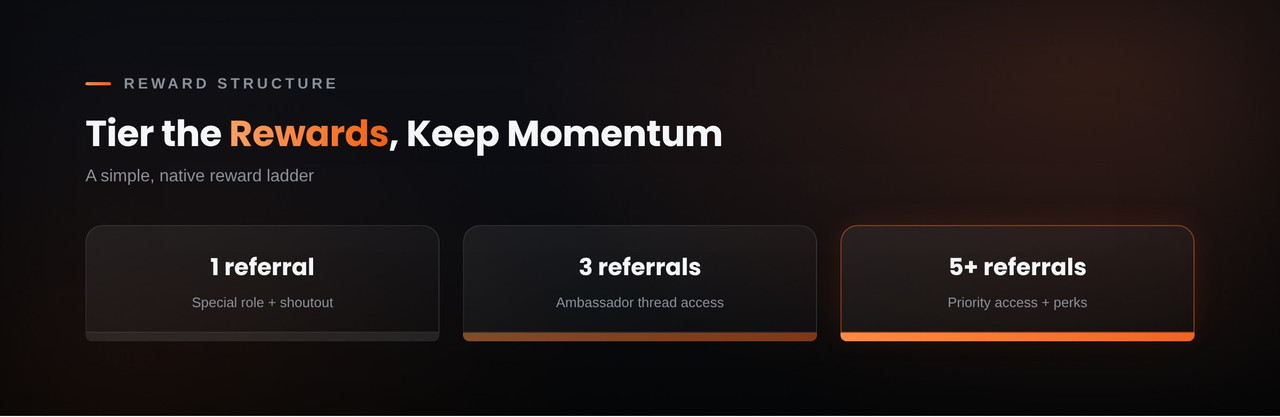
A single flat reward for any referral is a reasonable starting point, but tiering it further tends to sustain enthusiasm longer. A modest reward for the first referral gets people started. A bigger one, an ambassador-style role, a shoutout, priority access to whatever launches next, for members who bring in several, keeps your most active recruiters motivated well past their first successful invite, rather than letting the incentive flatten out after one use.
Recognize top referrers publicly, not just privately
Beyond formal rewards, simply and visibly recognizing the members who refer the most people, a mention, a leaderboard, a dedicated shoutout channel, tends to reinforce the behavior on its own. People who are already inclined to recruit friends often respond as strongly to visible recognition as they do to the reward itself. This kind of visible recognition is part of a broader pattern; how to keep members engaged in a community covers why it works so well beyond just referrals.
Making Sharing Effortless
Friction kills referral programs faster than a weak reward structure ever does. This is the part most admins underestimate.
Fix the basics of the link itself
Use a permanent invite link, not one that expires and quietly breaks the moment someone tries to click it a week after it was shared. Nothing kills a referral faster than a dead link sitting in an old message. Make the link easy to find too, pinned somewhere obvious rather than buried three channels deep where a motivated member would need to go hunting for it.
Create natural moments to share, not just cold asks
A referral ask that arrives out of nowhere feels transactional. A referral opportunity that arrives attached to a genuine moment, an upcoming event worth inviting a friend to, a big win a member just had that's worth showing off, a milestone the community is celebrating, feels natural instead. Community builders who've grown large servers organically consistently point to hosting events specifically because they create a built-in, low-pressure reason for members to invite people they know, without it ever feeling like a marketing ask.
Turning specific moments into referral opportunities
A few concrete moments tend to work particularly well: right after a member gets real, visible value (a win they post about, a milestone they hit), right before a live event or session that's genuinely worth bringing a friend to, and at natural community high points, an anniversary, a big announcement, a particularly good week of discussion. Prompting a share at these specific moments, rather than through a generic, standing "refer a friend" reminder, tends to produce noticeably better results, because the ask arrives exactly when the member's enthusiasm is highest.
Make the "how" as visible as the "why"
Even highly motivated members sometimes don't refer simply because they're unsure how, where the link is, what the reward actually is, whether it's still running. Posting the mechanics clearly in an easy-to-find channel, and periodically reminding members it exists, removes a surprisingly common barrier that has nothing to do with willingness and everything to do with visibility.
Tracking Referrals That Convert
Not all referral traffic is created equal, and treating every new join from a referral link the same way misses the point of running the program at all.
Track the source, then track what happens next
Using invite tracking, whether that's Discord's own built-in invite tracker or a dedicated bot, lets you see exactly which link brought in which member. That's the easy part. The harder, more valuable part is following that member past the initial join to see whether they actually stuck around and, eventually, whether they became a paying member.
The real question isn't how many clicks, it's how many stayed
A referral link that generates a hundred clicks and five members who stay and pay is worth more than one that generates five hundred clicks and nobody who sticks around. Tracking clicks alone tells you about curiosity. Tracking retention and conversion by referral source tells you whether the program is actually working.
Use what you learn to focus the program
Over time, this kind of tracking usually reveals that certain members, certain moments, or certain channels of sharing produce dramatically better referrals than others. Once that pattern is visible, it's worth deliberately encouraging more of exactly that, rather than treating every referral opportunity as equally valuable.
A concrete example of what this reveals
Say tracking shows that referrals shared right after a live event convert to paying members at twice the rate of referrals shared through a standing pinned link. That's not a coincidence, it reflects genuine enthusiasm at a specific moment translating into a genuinely engaged new member, versus a colder, more passive invite. Once that pattern is visible, the obvious move is to lean harder into event-driven referral prompts and treat the standing link as a supplementary channel rather than the primary one, reallocating effort toward what the data actually shows is working rather than what felt intuitively like it should work.
A Worked Example: Setting Up a Simple Referral Structure
Picture a mid-sized paid community with around 300 members. A simple, tiered structure might look like this: bring in one paying member and unlock a distinct role and a shoutout in a recognition channel. Bring in three, and get access to a private, ambassador-only thread with early previews of upcoming content. Bring in five or more within a quarter, and get a meaningful, visible reward, priority access to a live session, a free month, a direct line to the admin for feedback. None of this requires cash rewards or complex tracking software beyond a basic invite-tracking bot; it requires clear, visible tiers and consistent follow-through when someone hits one.
Common Mistakes Communities Make With Referral Programs
- Making the reward too small to notice, or too complicated to understand. If members can't quickly explain what they get for referring someone, the program isn't going to move much behavior regardless of how generous the reward technically is.
- Only asking for referrals during a launch, then going quiet. Referral programs that exist as a one-time push around a launch miss the much larger, ongoing opportunity: happy members are willing to refer people continuously, not just in the first month.
- Rewarding the click instead of the outcome. Paying out a reward the moment someone clicks an invite link, before that person has actually stuck around or converted, encourages exactly the wrong behavior and can attract low-quality, low-intent joins purely chasing the reward.
- Burying the referral mechanics somewhere nobody finds them. A referral program that isn't visible, pinned, or periodically reminded of might as well not exist. Even highly satisfied members often simply forget it's there.
Quick FAQ
- Do referral programs work for small communities, or only large ones?
They work at essentially any size, and arguably matter more for smaller communities, where a handful of well-placed referrals can meaningfully move the needle on total membership. The mechanics scale down fine, a leaderboard with ten names is still motivating.
- What's a reasonable reward to start with if I'm not sure what my members will value?
Start with something Discord-native and low cost, a special role or early access, and watch what actually gets people talking about it. It's easier to add a bigger tier later than to walk back an expensive reward that turned out not to be the right motivator.
- How do I stop a referral program from attracting the wrong kind of member?
Track retention by referral source closely, and if a particular channel or incentive is pulling in members who churn quickly, adjust or retire that specific mechanic rather than assuming referral programs in general don't work for your community.
Further Reading
- ReferralHero's referral program research — trust and retention data behind referral-driven growth
- Extole's referral program examples and Journal of Marketing data — the peer-reviewed churn and lifetime-value research cited above
- Discord's community-led growth story — how invite links built the platform's early growth almost entirely through word of mouth
Once a referred member actually joins, what happens in their very first conversation is what decides whether that referral was worth the effort of running the program at all. A referral program can bring the right people to the door, but what happens after they walk in is still what determines whether they stay.