

Why New Members Join and Then Disappear
Growing a paid community often feels like a numbers game.
You spend weeks creating content, promoting your community on social media, collaborating with other creators, and answering questions from potential members. Eventually, someone decides to subscribe, joins your Discord server, and for a moment, it feels like all that effort has paid off. !!! Then, a month later, they don't renew.
At first, it can be confusing.
The resources were there.
The community was active.
You answered questions when people asked them.
So why did they leave?
The reality is that member retention is rarely determined by one major event. Most members don't leave because they had a bad experience. They leave because they never experienced enough good ones.
A successful paid community isn't measured by how many people join every month.
It's measured by how many people decide to stay.
That's an important distinction because subscriptions aren't built on one-time purchases. They're built on recurring value. Every renewal is a member saying:
"This community continues to help me, so it's worth paying for another month."
If members don't reach that conclusion, they'll quietly disappear, no matter how many new people continue joining.
This is one of the biggest challenges community owners face.
Many spend countless hours trying to acquire new members while giving very little attention to the experience members have after joining. Marketing improves, acquisition grows, and new subscriptions increase—but retention quietly declines in the background.
The result is a community that constantly feels like it's starting over.
Members join.
Members leave.
The cycle repeats.
Eventually, growth begins to stall because every new subscriber simply replaces someone who cancelled.
Breaking that cycle starts with understanding something that many creators overlook.
Retention begins the moment someone joins your community.
Not when they're about to cancel.
Not when you send them a renewal reminder.
Not when you notice they've gone inactive.
The experience a member has during their very first week often determines whether they'll still be around next month.
This guide explores why new members quietly disappear, where communities unknowingly lose them, and how you can create an experience that encourages people to remain active long after they've joined.
Why Members Leave in the First Week
The first week inside your community is the most important period of a member's journey.
Not because they'll learn everything during those seven days.
Not because they'll immediately build friendships.
But because it's the period where they decide whether joining your community was the right decision.
Think about any subscription you've ever purchased.
Whether it's a streaming platform, an online course, a gym membership, or another paid community, you're constantly evaluating your decision during those first few days.
You're asking yourself questions like:
- Is this what I expected?
- Am I getting value already?
- Was this worth paying for?
- Can this actually help me?
- Do I see myself continuing to use this?
Your members are doing exactly the same thing.
The problem is that many community owners assume the sale is already complete.
Someone paid.
They joined.
Job done.
In reality, they're still deciding whether they'll become a long-term member.
That's why the first week shouldn't simply introduce members to your Discord server.
It should convince them that joining was the right decision.
People Don't Renew Communities They Never Experienced
One of the biggest misconceptions about paid communities is that members leave because they don't use the resources.
More often than not, they leave because they never discovered them.
Imagine joining a community with:
- dozens of channels
- hundreds of resources
- multiple bots
- years of conversations
- several community categories
To the owner, it represents months or years of hard work.
To a new member, it can feel overwhelming.
Where should they begin?
Which resources matter most?
Who should they talk to?
How do they know what's still relevant?
Instead of feeling excited, many members feel lost.
When people become overwhelmed, they usually do one of two things.
They either leave immediately.
Or they tell themselves they'll come back later.
Later becomes tomorrow.
Tomorrow becomes next week.
Before they realise it, their first month has almost ended without them experiencing any meaningful value.
Communities rarely lose members because they lacked value.
They lose members because they failed to help members discover that value quickly enough.
Your Goal Is to Deliver a Quick Win
The easiest way to prevent early churn is by helping members experience progress as quickly as possible.
That progress doesn't need to be extraordinary.
It simply needs to answer one important question:
"Am I already benefiting from being here?"
A quick win could be:
- Receiving helpful advice from another member.
- Getting feedback on a project.
- Solving a problem they've been struggling with.
- Meeting someone with similar goals.
- Learning something they immediately apply.
- Joining their first community discussion.
These experiences create momentum.
Instead of thinking:
"I'll look around later."
Members begin thinking:
"I'm glad I joined."
That small mindset shift dramatically increases the chances they'll continue participating.
Because people naturally return to places where they experience progress.
Great Onboarding Removes Uncertainty
Many communities treat onboarding as an administrative task.
Assign a role.
Display the rules.
Unlock the channels.
Welcome the member.
Technically, they've been onboarded.
Practically, nothing meaningful has happened.
Real onboarding isn't about permissions.
It's about reducing uncertainty.
Every new member should know:
- where to begin
- who to talk to
- which channel to visit first
- how to ask questions
- how to get help
- what success looks like inside the community
The fewer decisions members need to make, the easier it becomes for them to participate.
A confused member rarely becomes an active member.
A guided member often does.
Information Isn't Enough
Another common mistake is believing that resources alone create value.
Many owners spend weeks creating:
- video libraries
- PDFs
- templates
- recorded workshops
- documentation
All of those resources are useful.
None of them replace human interaction.
People don't join paid communities purely for information.
If information alone was enough, YouTube, blogs, AI tools, and free resources would replace every membership community.
Instead, people join because they want:
- accountability
- conversations
- feedback
- networking
- encouragement
- direct access to experienced people
Those experiences can't simply be downloaded.
They're created through participation.
That's why your community shouldn't feel like a resource library with a Discord server attached.
It should feel like a group of people helping each other make progress.
Show Members the Community Is Alive
One of the quickest ways to reassure new members they've made the right decision is by showing them that the community is active.
People naturally enjoy being part of environments where things are happening.
Imagine joining a server and immediately seeing:
- members helping one another
- ongoing conversations
- people celebrating wins
- moderators actively participating
- announcements about upcoming community calls
Instantly, the community feels alive.
Now compare that with joining a server where the most recent conversation happened four days ago.
The resources might be identical.
The perceived value isn't.
Activity creates confidence.
Members are far more likely to remain engaged when they believe they're joining something that's growing rather than something that's slowly becoming inactive.
The First Week Isn't About Selling
One mistake many communities make is trying to sell more during a member's first few days.
Upsells.
Higher tiers.
Premium coaching.
Additional offers.
At that stage, members don't need another sales pitch.
They need reassurance that their original purchase was worthwhile.
Focus entirely on helping them succeed.
Answer questions.
Celebrate progress.
Introduce them to other members.
Guide them toward useful resources.
The sale has already happened.
Now your responsibility shifts toward creating an experience worth renewing.
That's an entirely different objective.
The First Week Sets Everything Else in Motion
Communities aren't built through one unforgettable moment.
They're built through consistent positive experiences.
The first week simply lays the foundation.
If members leave those first few days feeling confident, welcomed, and excited about what's ahead, they'll naturally continue exploring your community.
If they leave feeling confused or disconnected, re-engaging them becomes significantly more difficult.
That's why every successful community owner should ask themselves one simple question:
"If someone joined today, would they experience enough value during their first week to confidently renew next month?"
If the answer is yes, you've already solved one of the biggest retention challenges that paid communities face.
If the answer is no, that's where your attention should be first.
The Silent Drop-Off Nobody Tracks
When community owners think about retention, they often focus on cancellations.
Someone ends their subscription.
Their access is removed.
Another member has churned.
On paper, that's when they left.
In reality, they left long before that.
The cancellation was simply the final step in a process that had already been unfolding for weeks.
This is what makes retention so difficult.
Members rarely announce they're thinking about leaving.
They don't message the owner saying:
"I'm losing interest."
They don't open a support ticket asking for help.
They simply become quieter.
They participate a little less each week.
Eventually, they disappear altogether.
By the time the subscription expires, they've already detached themselves from the community.
If you only measure cancellations, you're seeing the end of the story.
The real problem started much earlier.
Members Usually Leave Mentally Before They Leave Financially
Think about your own subscriptions.
Whether it's Netflix, Spotify, a gym membership, or another online service, you probably didn't cancel the moment you stopped using it.
You simply stopped opening it.
Weeks later, maybe even months later, you remembered you were still paying for it and finally cancelled.
Paid communities are no different.
The moment someone stops opening Discord regularly, they're already drifting away.
That doesn't mean they're guaranteed to leave.
But it does mean the relationship is weakening.
The goal isn't to convince members to stay after they've cancelled.
The goal is to prevent them from reaching that point in the first place.
Silence Is a Better Metric Than Churn
Most dashboards track:
- New members.
- Monthly recurring revenue.
- Renewals.
- Churn.
Those metrics are important.
But they don't tell you whether members are actually engaged.
A much better question is:
"Who's gone quiet?"
Maybe they haven't sent a message in three weeks.
Maybe they haven't attended a community call this month.
Maybe they haven't reacted to an announcement recently.
Maybe they introduced themselves on day one and then never spoke again.
These are the signals worth paying attention to.
Because inactivity almost always comes before cancellation.
The communities with the strongest retention don't just celebrate new members.
They actively notice the quiet ones too.
A Community Should Feel Alive Every Day
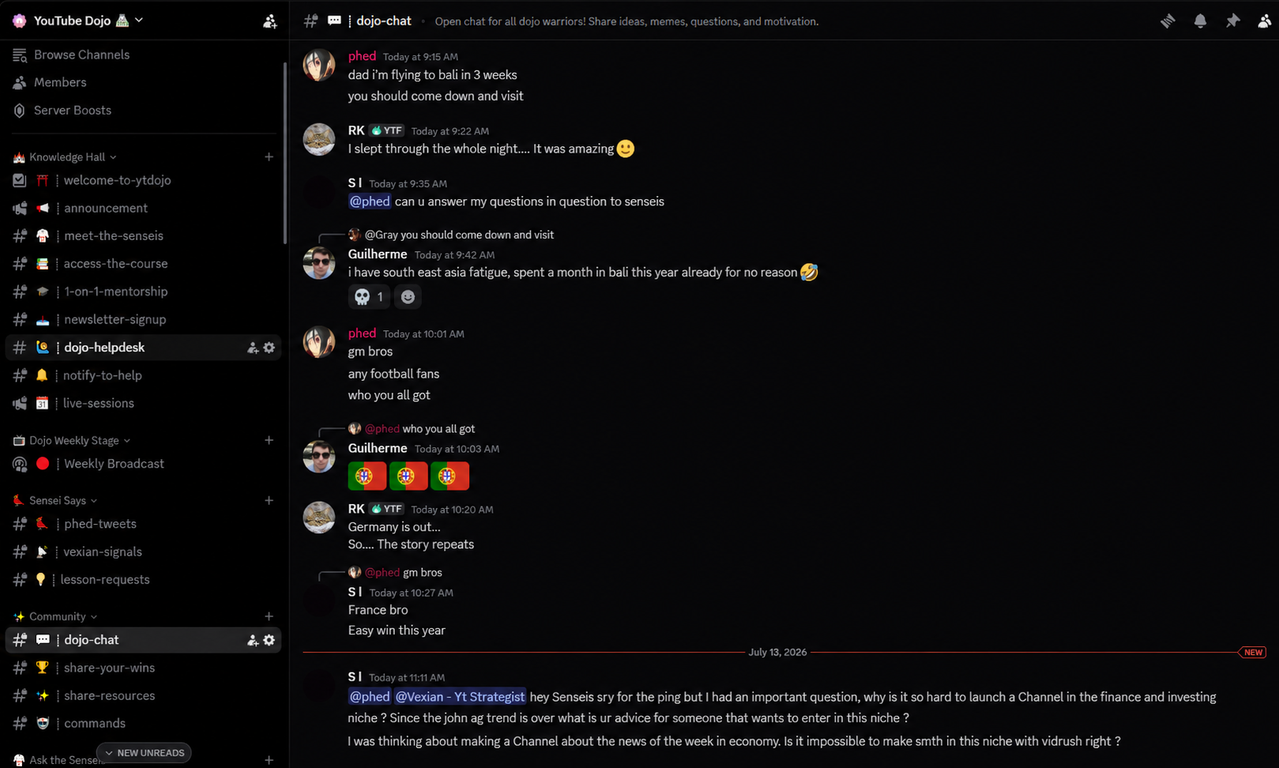
One of the defining characteristics of a successful paid community is that it always feels active.
Members shouldn't need a major announcement, product launch, or scheduled event as an excuse to open Discord.
Instead, there should always be something happening.
Someone is asking for advice.
Another member is celebrating a milestone.
A discussion is gaining momentum.
An event is approaching.
A community challenge is underway.
Staff are chatting with members.
These moments may seem insignificant on their own.
Collectively, they create momentum.
People naturally enjoy being part of communities where something is always happening.
Not because they want constant entertainment.
Because activity creates confidence.
When members open Discord and consistently see conversations taking place, they immediately feel reassured that they're part of an active community.
That reassurance has a huge impact on retention.
Communities don't feel valuable because of how many channels they have.
They feel valuable because of the people inside them.
Stay Grounded and Be Present
One mistake many community owners make is treating Discord like customer support.
They appear when someone asks a question.
They solve the problem.
Then they disappear again.
While technically helpful, it doesn't build a community.
Members want to know there's a real person behind the server.
Someone who's genuinely interested in seeing them succeed.
That doesn't mean spending ten hours a day inside Discord.
It means being consistently present.
Reply to conversations.
Jump into discussions without being tagged.
Ask members how their projects are progressing.
Welcome new members personally whenever you can.
Congratulate people when they achieve something.
Sometimes a simple reply is enough to completely change someone's experience.
When members know they'll receive a response, they're naturally more comfortable participating again.
Community owners set the tone.
If you're visible, approachable, and engaged, members are far more likely to behave the same way.
Community Calls Build Relationships
One of the most effective ways to keep members engaged is surprisingly simple.
Talk to them.
Not through announcements.
Not through automated messages.
Actually talk to them.
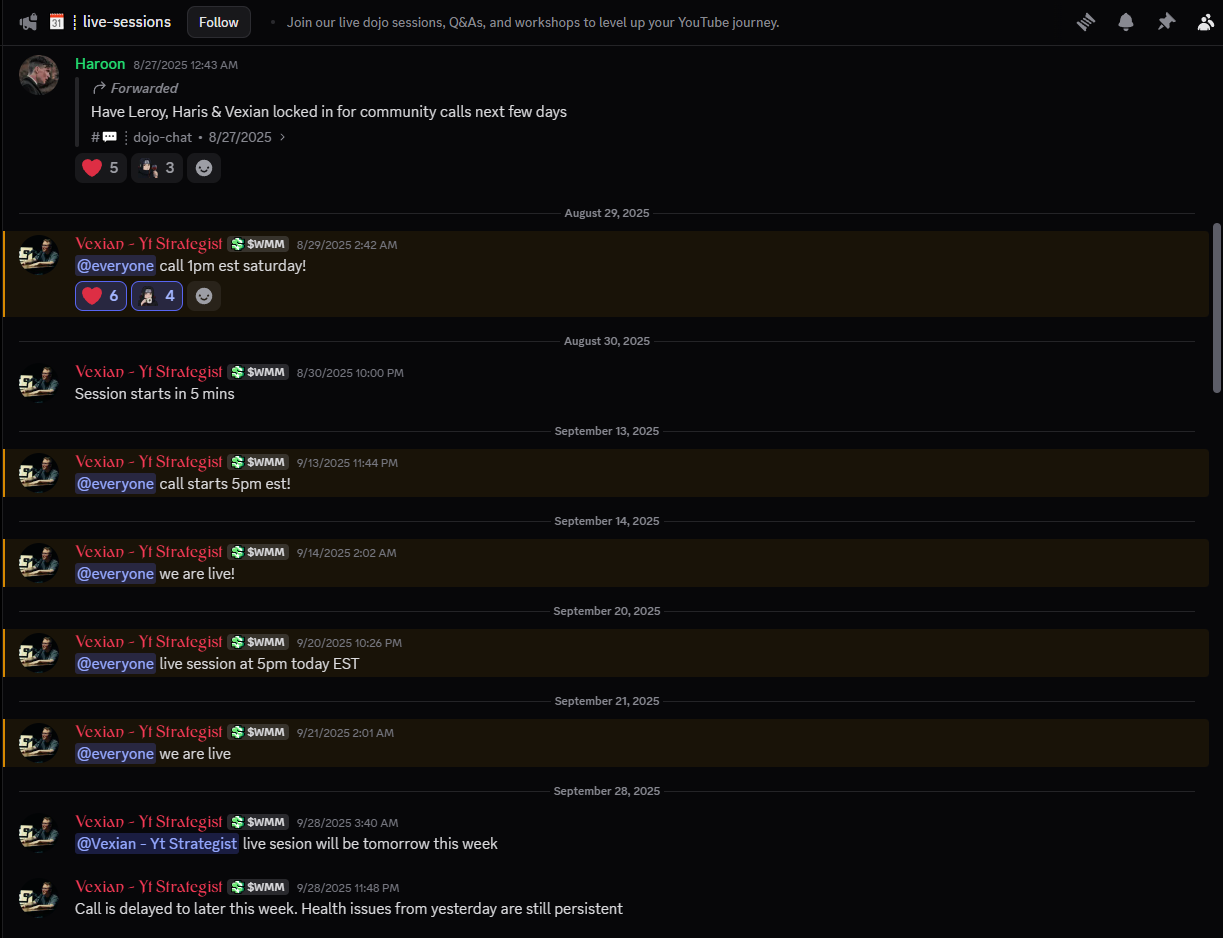
Hosting regular community calls gives members a reason to return while strengthening relationships that simply can't be built through text channels alone.
These calls don't always need to follow a strict agenda.
Some of the best sessions are informal.
Members ask questions.
Share recent progress.
Discuss challenges.
Celebrate wins.
Help one another.
The value isn't just the information being shared.
It's the relationships being built.
People stop recognizing usernames.
They begin recognizing voices.
That familiarity creates trust.
The more comfortable members become with one another, the more likely they are to continue participating between calls as well.
Community calls also create rhythm.
If members know there's always a session every Thursday evening, they have another reason to remain connected to the community.
Over time, those recurring touchpoints become part of their routine.
That's exactly what you're trying to achieve.
Don't Wait for Members to Start Every Conversation
Another misconception is that conversations should happen naturally.
Sometimes they do.
Most of the time, they need a little help.
That's perfectly normal.
Community owners shouldn't be afraid to start discussions.
Ask interesting questions.
Share industry news.
Post a thought-provoking topic.
Celebrate someone's achievement.
Encourage members to give their opinions.
It only takes one good conversation to spark ten more.
The goal isn't to dominate every discussion.
It's to create enough momentum that members begin contributing on their own.
Think of yourself as lighting the first spark.
Eventually, the community keeps the fire going.
Encourage Members to Share Their Wins
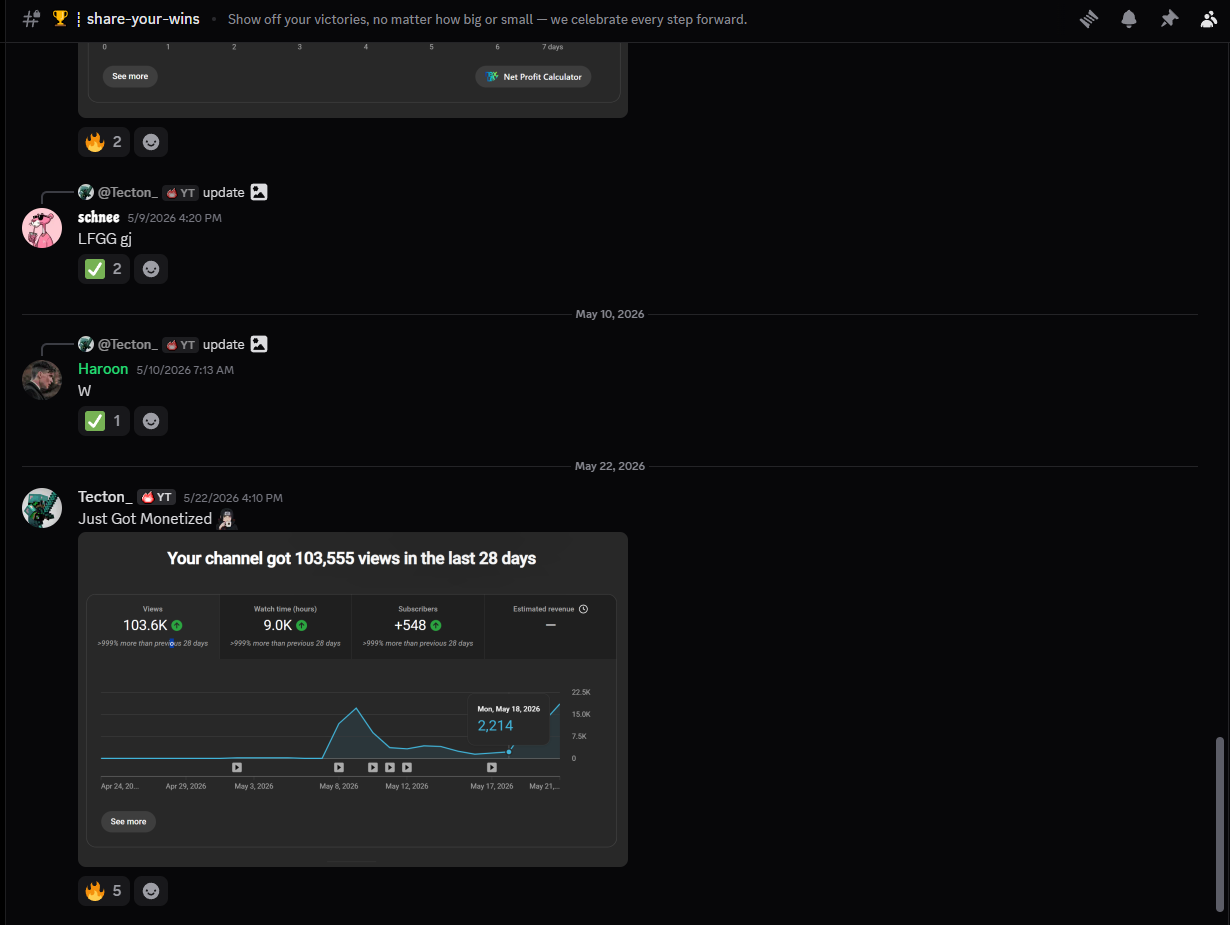
One of the easiest ways to create positive momentum is by giving members a dedicated place to celebrate their progress.
A simple #member-wins channel can completely change the atmosphere inside a community.
Members might share things like:
- Signed their first client.
- Closed their biggest month yet.
- Passed a funded trading challenge.
- Published their first course.
- Landed a new job.
- Lost their first 10kg.
- Finished a project they'd been putting off.
These aren't just personal milestones.
They're proof that people inside the community are making progress.
That matters.
Especially for quieter members.
Someone who's been doubting whether their subscription is worthwhile might see another member achieving great results and think:
"If they can do it, maybe I can too."
Progress becomes contagious.
Don't stop at simply creating the channel.
As the owner, actively participate.
React to every post.
Congratulate members.
Ask follow-up questions.
Highlight standout wins during community calls.
Recognition encourages people to keep sharing, and those stories become some of the strongest forms of social proof your community can have.
Activity Creates Habits
Ultimately, your goal isn't to convince members to check Discord every day.
It's to make checking Discord feel natural.
Habits aren't created through one incredible event.
They're created through consistency.
Someone opens Discord because they enjoyed yesterday's discussion.
They come back tomorrow because another member replied.
The following week they join a community call.
A few days later they celebrate a small win.
Another member congratulates them.
Without realizing it, visiting the community has become part of their weekly routine.
That's one of the strongest indicators of long-term retention.
Communities become difficult to leave when they become part of someone's routine.
And routines are built through consistent interaction—not one-off moments.
The Moments Where You Lose Them
One of the biggest misconceptions about community retention is that members leave because of one major disappointment.
In reality, it's almost never one big moment.
It's dozens of small moments where members expected to experience value and didn't.
Nobody replied to their question.
They missed another community call.
A discussion they started received no responses.
The server felt unusually quiet.
An event came and went without them joining.
Weeks passed without them feeling any real sense of progress.
None of those experiences are enough to make someone cancel immediately.
But over time, they slowly chip away at the relationship members have with your community.
Eventually, the question changes from:
"Should I renew?"
to
"Why am I still paying for this?"
That's when retention becomes incredibly difficult.
The best communities don't wait until members ask themselves that question.
They make sure the answer is obvious every single month.
Communities Are Built on Experiences, Not Resources
It's easy to assume that adding more resources automatically increases the value of your membership.
More templates.
More recordings.
More PDFs.
More exclusive channels.
While those additions can certainly help, they're rarely the reason people continue paying.
Think back to why members joined in the first place.
Most weren't looking for another folder full of downloadable resources.
They wanted:
- Better results.
- Accountability.
- Access to experienced people.
- Meaningful conversations.
- Motivation to keep going.
- A place where they felt understood.
Those experiences can't simply be uploaded to Discord.
They're created through interaction.
That's why the strongest communities focus less on constantly creating content and more on consistently creating experiences.
Every Interaction Either Strengthens or Weakens Retention
One of the simplest ways to think about retention is this:
Every interaction either gives members another reason to stay...
or another reason to leave.
A welcoming reply to a new member.
Someone answering a question quickly.
A moderator introducing two members with similar goals.
An interesting discussion.
A successful community call.
A celebration of someone's progress.
Each interaction strengthens the relationship.
On the other hand:
Questions with no replies.
Events nobody attends.
Announcements with no engagement.
Inactive staff.
Silent channels.
These experiences gradually weaken it.
Community building isn't about one grand gesture.
It's about consistently creating positive interactions that remind members why they joined.
Events Give Members Something to Look Forward To
One thing every successful community has in common is that members know there's always something coming up.
Communities that rely entirely on spontaneous conversations eventually lose momentum.
People become busy.
Discussions slow down.
Activity drops.
Regular events solve that problem by giving members recurring reasons to return.
These don't always have to be large productions.
In fact, simple events often perform best.
For example:
- Weekly community calls.
- Monthly AMAs.
- Live workshops.
- Guest speaker sessions.
- Office hours.
- Community challenges.
- Friendly competitions.
- Live project reviews.
The purpose of these events isn't simply to fill the calendar.
It's to create anticipation.
Members begin thinking:
"I don't want to miss Thursday's session."
That mindset is incredibly valuable.
Because communities thrive when members have reasons to come back before they even leave.
Give Back to the Community That Built Yours
As your community grows, it's easy to become focused on attracting the next member.
While growth is important, it's equally important to remember the people who already chose to support you.
Your existing members are the reason your community exists.
Find opportunities to give back.
Run surprise giveaways.
Host exclusive workshops.
Invite respected guest speakers.
Offer bonus coaching sessions.
Celebrate community milestones together.
Sometimes the highest-return activity isn't attracting another customer.
It's making your current members feel appreciated.
People notice when community owners genuinely care.
Those moments create loyalty that can't be replicated through discounts or marketing campaigns.
Celebrate Progress Publicly
Every community should make success visible.
One member lands their first client.
Another launches a business.
Someone else reaches a personal fitness goal.
Another finally passes an exam they've been preparing for.
These stories deserve attention.
Not because they promote the individual.
Because they inspire everyone else.
When members regularly see others succeeding, they're reminded that progress is possible.
The community transforms from:
"A place with useful information."
into
"A place where people actually achieve results."
That's a huge psychological difference.
It reinforces the value of remaining part of the community.
As the owner, make celebrating these moments part of your culture.
Highlight them in announcements.
Mention them during community calls.
Congratulate members personally.
Small gestures like these make people feel genuinely valued.
Culture Is What Keeps Members Around
Features can attract people.
Culture keeps them.
Two communities might have identical resources.
The same number of channels.
The same events.
The same pricing.
Yet one feels energetic while the other feels empty.
The difference is usually culture.
Culture is created by:
- welcoming new members
- encouraging collaboration
- recognizing contributions
- celebrating progress
- treating everyone with respect
- making participation feel rewarding
It's difficult to define.
But members notice it immediately.
Communities with strong cultures naturally encourage members to contribute because people enjoy being there.
That's ultimately what you're trying to build.
Not just another paid Discord server.
A place people genuinely enjoy returning to.
Catching Members Before They Go Quiet
The best time to retain a member isn't after they've cancelled.
It's before they begin drifting away.
The challenge is recognizing that drift early enough.
A member who's becoming inactive won't usually tell you.
Instead, they'll quietly participate less and less.
That's why community owners should actively look for small warning signs.
Has someone who used to post regularly suddenly disappeared?
Has a familiar face stopped attending community calls?
Has a member who normally celebrates their wins gone silent?
These changes deserve attention.
Not because you're trying to convince people to stay.
Because you're trying to understand whether they're still getting value from the community.
Sometimes a simple check-in is all it takes.
A quick message asking:
"Hey, haven't seen you around lately. How's everything going?"
can completely change someone's perception of your community.
It reminds them that they're more than just another subscription.
They're a valued member.
Don't Wait Until Renewal Day
One of the biggest retention mistakes community owners make is waiting until renewal is approaching before thinking about engagement.
By then, it's usually too late.
Retention isn't something you build during the final week of a subscription.
It's built every single week before that.
Every community call attended.
Every conversation joined.
Every member celebrated.
Every event hosted.
Every helpful reply.
Every small interaction contributes to one larger feeling:
"I'm glad I'm part of this community."
When members consistently feel that way, renewal becomes the natural outcome rather than another purchasing decision.
What You Should Do Next
Retaining members isn't about finding one perfect strategy.
It's about consistently creating an experience that people want to come back to.
Start by looking at your community through the eyes of a new member.
Would they immediately understand where to begin?
Would they experience value during their first week?
Would they meet other members?
Would they have a reason to return tomorrow?
Beyond onboarding, ask yourself another important question.
What happens after that first week?
Are community calls happening regularly?
Are members celebrating each other's wins?
Are events creating excitement?
Is the community owner visible and approachable?
Does the server genuinely feel alive?
If the answer to those questions is yes, you're already building one of the strongest foundations for long-term retention.
Because successful paid communities aren't built by maximizing first-time purchases.
They're built by creating an experience that members genuinely don't want to leave.
When people consistently learn, contribute, build relationships, celebrate progress, and feel like they belong, renewing their membership stops feeling like another expense.
It simply becomes the easiest decision they make that month.