

How to Grow a Paid Discord Community
Discord doesn't have an ads dashboard. There's no boost button, no audience targeting panel, no way to hand the platform money and buy your way into more members the way you might on other channels. For anyone used to paid acquisition elsewhere, that can feel like a limitation. In practice, it's one of the better things about growing on Discord, because it forces growth to come from something that actually compounds instead of something you have to keep paying for forever.
Where Paid Community Members Come From
Look closely at almost any healthy paid Discord community and the growth traces back to a small set of sources, repeated consistently over a long stretch of time, rather than any single clever tactic.
The platform's own history is the clearest proof
Discord's early growth is a useful case study precisely because it happened with essentially no advertising budget behind it. The founders didn't buy their way to an audience, they went to where their target users already were, active gaming subreddits, posted invite links, and then personally showed up inside the resulting servers to welcome newcomers and answer questions directly. The result was authentic, organic, snowballing word of mouth, not a growth hack. The platform now handles more than 150 million active users and 19 million active servers weekly, and that scale grew almost entirely from the same mechanic: people inviting people they already trusted.
Existing members are your highest leverage growth channel
The single strongest predictor of whether someone joins and sticks around is whether a friend brought them in. A recommendation from someone already inside the community carries a kind of trust no ad copy can replicate, and members who arrive this way tend to integrate faster because they already have one familiar face in the room.
Why existing members convert new joins so much faster
There's a practical reason this matters beyond just trust: a member who's invited by a friend typically arrives already understanding roughly what the community is about, what tone to expect, and what value they're likely to get. That context does a meaningful chunk of the onboarding work before the new member has even joined, which is part of why referral driven members consistently show stronger early engagement than members who found the community cold, through an ad, a discovery listing, or a random link.
Content that shows, rather than tells
A short clip from an event, a screenshot of a genuinely great conversation, a specific member win worth bragging about, all of this does more to pull the right people in than a generic "join our community" post ever will. It gives outsiders something concrete to react to, rather than a vague invitation they have no context for.
Partnerships with adjacent communities
Communities that share an audience but aren't direct competitors are one of the most underused growth channels available. A cross promotion, a joint event, or simply showing up and genuinely contributing in a partner server before ever mentioning your own, tends to outperform cold outreach by a wide margin, largely because it arrives with built-in credibility rather than as an unsolicited pitch.
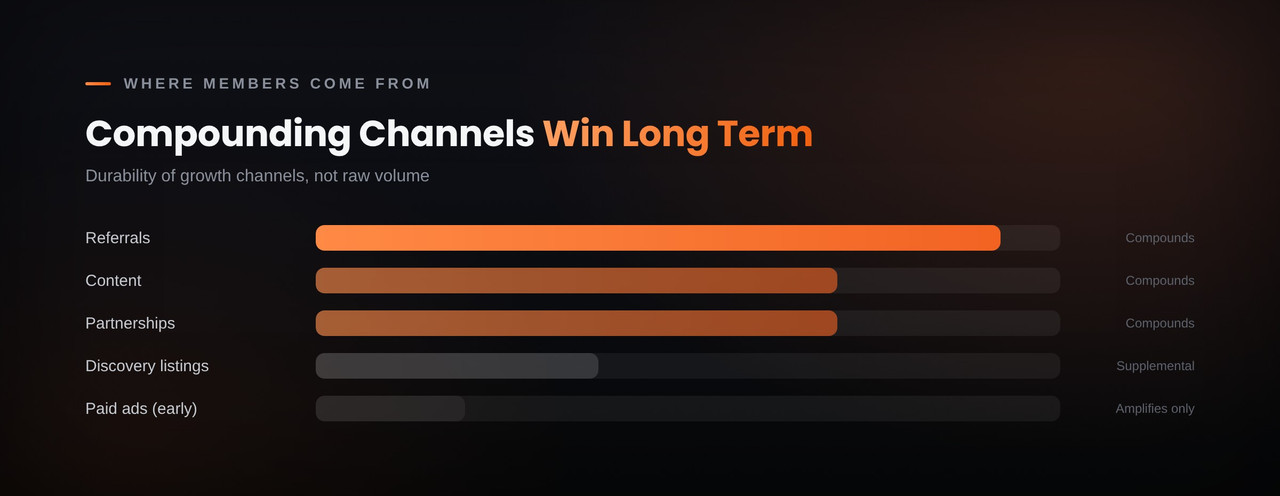
Content and Referrals That Compound
The sources above only matter if they compound over time, which is where a lot of growth effort quietly gets wasted on things that don't actually build on themselves.
Referrals carry trust that content alone can't
People act on a friend's recommendation far more readily than on any piece of marketing content, no matter how well produced. This is worth building real structure around rather than leaving to chance; how to run a referral program for your community covers the mechanics of making sharing easy and rewarding, which matter as much as the impulse to share in the first place.
Consistency beats intensity
A single viral moment feels great and rarely repeats itself. What actually compounds is showing up in the same places, consistently, over months: the same handful of partner communities, the same content rhythm, the same genuine presence in spaces where your future members already spend time. David Spinks, cofounder of CMX, who has advised community teams at Google, Airbnb, and Udemy, has made the same point repeatedly in his own work: communities that treat growth as a compounding, ongoing practice consistently outperform ones chasing a single breakout moment. None of this is exciting to describe, but it's the difference between communities that keep growing years in and ones that spiked once off a lucky post and quietly plateaued.
Discovery listings still matter, even if they're not the main event
Sites like Disboard and Top.gg exist specifically to help people discover Discord servers by topic, and while they're rarely the primary growth engine, a well-optimized listing catches genuinely interested people who are actively searching, which makes it a low-effort addition worth having even if it's not where you focus most of your energy. Not everyone this reaches will be ready to join a paid tier immediately, which is exactly where lead magnets to grow a community earn their keep, keeping curious-but-not-ready people warm instead of losing them for good.
Why Ads Rarely Work Early
Paid traffic doesn't fix a community, it amplifies whatever's already true about it. That's a critical distinction most admins learn the expensive way.
Ads accelerate what's already working, and what isn't
If onboarding and retention are already solid, a modest ad spend can genuinely accelerate growth that was already headed in the right direction. If they're not solid yet, ads just buy a faster, more visible version of the same churn cycle, a spike in new joins followed by an even faster drop-off, because there's nothing in place to hold people once they arrive. The math gets worse, not better, when you're paying to bring people into a leaky bucket.
Beware of growth that looks impressive but isn't real
There's a pattern worth naming explicitly, sometimes called "unnatural growth" by community builders who've seen it up close: a server that balloons in member count almost overnight, through mass invites, bot traffic, or aggressive cross-posting, without any of it translating into actual engagement. It looks great on a member counter and means almost nothing. If growth ever feels suspiciously fast and painless, that's usually a signal to slow down and check what's actually happening beneath the number, not a reason to celebrate.
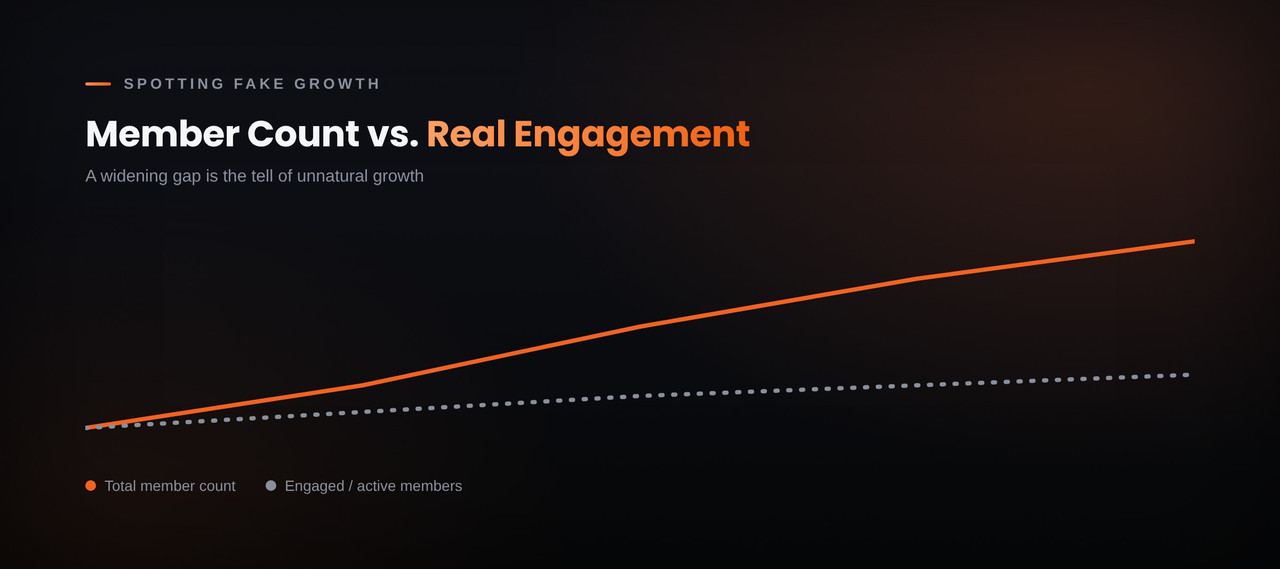
A quick way to check if your own growth is real
Compare the rate your member count is climbing against the rate your engaged, active member count is climbing over the same period. If total members are up 40% over a quarter but posting, reacting, and event attending members are only up 5%, that gap is the tell. Healthy, durable growth tends to show both numbers moving together, even if not at identical rates. A widening gap between them is the clearest early sign that recent growth tactics pulled in volume without pulling in genuine interest.
Member count is a vanity metric on its
own More joins doesn't equal more growth if activation and retention aren't tracked alongside it. A community that adds 500 members a month but retains none of them past week two hasn't actually grown anything, it's just cycled the same number of people through the front door repeatedly. Track activation and retention rates as closely as you track new joins, or the new-join number will quietly mislead you. (For the actual stack that makes this trackable, see the tools you need to run a paid community.)
The Slow Grind That Actually Grows
Real, durable growth here looks unglamorous, and that's exactly why so many communities skip it in favor of something that feels faster.
A handful of genuine partnerships beats mass outreach
Blasting the same partnership request into every server's partnership channel reads as spam, and it's usually treated that way. Identifying five to ten genuinely complementary communities and building actual relationships, offering something valuable first rather than leading with an ask, produces far better results than a hundred generic cold messages ever will.
Show up before you promote
Joining relevant conversations on Reddit, in forums, or in adjacent Discord servers, and being genuinely useful there before ever mentioning your own community, builds the kind of credibility that makes an eventual invite land as welcome rather than intrusive. This is slower than dropping a link everywhere, deliberately so, and it's also far more durable.
Niche specificity is a growth lever, not a limitation
"A community for creators" is forgettable. "A community for creators pricing their first paid cohort" is memorable, magnetic to exactly the right people, and dramatically easier to create content and partnerships around, since everything you make can speak directly to a specific person's specific situation instead of trying to be broadly relevant to everyone.
Consistency over months, not a single push
None of this compounds if it's treated as a one time campaign. The communities that keep growing years after launch are the ones that kept doing the unglamorous version of this work steadily, month after month, long after the initial launch excitement wore off for everyone else.
Common Mistakes Communities Make When Trying to Grow
- Mistaking activity for growth. A flurry of promotional posts across every platform at once can feel productive without actually moving the number that matters: engaged, retained members. It's easy to confuse motion for progress here.
- Chasing every partnership opportunity instead of a focused few. Saying yes to every cross-promotion request dilutes the effort behind each one and often pairs your community with audiences that don't actually overlap well, producing joins that never really stick.
- Promoting before the community is ready to receive new members well. Driving a wave of new joins into a server with a weak or nonexistent onboarding flow just produces a wave of people who leave within the first week, wasting whatever effort went into reaching them in the first place.
- Giving up on organic tactics too early because they're slower than expected. Word-of-mouth and partnership-driven growth compounds, but it compounds slowly at first. Communities that abandon these tactics after a month or two, before the compounding effect has had time to build, often conclude "organic doesn't work" when the real issue was simply not giving it enough time.
A Simple Starting Checklist
For admins who want a concrete place to begin rather than trying everything at once:
- Fix onboarding first. Growth before retention is solid just produces faster churn. Make sure new members are actually staying before investing heavily in bringing more of them in.
- Identify 5-10 genuinely adjacent communities. Not competitors, but communities whose members would plausibly be interested in yours too. Start real conversations with those specific admins, not a mass outreach blast.
- Set up a permanent, trackable invite link. Make sure it's pinned somewhere obvious and never expires, so any effort spent driving people toward it isn't wasted on a broken link.
- Create one piece of content that shows, rather than tells, what the community is like. A clip, a screenshot, a specific story worth sharing, something concrete enough that someone unfamiliar with the community can immediately picture what it's like to be inside it.
- Give current members an easy, natural reason to invite someone. Tie it to an actual moment, an event, a milestone, rather than a cold, standing ask.
Quick FAQ
- Is it ever worth running paid ads for a Discord community?
Once onboarding and retention are genuinely solid, paid promotion can meaningfully accelerate growth that's already working. Before that point, it usually just accelerates churn instead, so it's worth treating as a later stage lever rather than a starting point.
- How many partner communities should I realistically try to build relationships with?
A small, focused number, generally five to ten genuinely complementary communities, tends to outperform a much larger number of shallow, transactional partnership pings. Depth beats breadth here.
- What's a realistic timeline for organic Discord growth to show real results?
Months, not weeks, in almost every honest account of how this actually plays out. Communities that look like they grew fast almost always had months of quieter, unglamorous groundwork happening before the visible growth started.
- Should I worry more about member count or engagement rate as I grow?
Engagement and retention, without question. A larger but disengaged community is worth less than a smaller, genuinely active one, both for the member experience and for eventual monetization, since paying members overwhelmingly come from the engaged segment, not the raw total.
- How do I find the right partner communities to reach out to?
Look for communities whose members share your target audience's interests but aren't a direct substitute for what you offer. A trading-education community and a broker's community might share an audience without competing directly, for instance. Search Discord discovery listings, adjacent subreddits, and creator communities in your topic area as a starting point.
- Is it worth listing my server on directories like Disboard or Top.gg?
It's a reasonable low-effort addition, particularly for catching people actively searching for a community like yours, but it's rarely the channel that drives most sustainable growth on its own. Treat it as a supplement to referral and content-driven growth, not a replacement for either.
- What's a realistic first sign that organic growth tactics are working?
Look for an uptick in joins that specifically come through tracked referral links or partner community mentions, rather than just a rise in total member count, which could be coming from anywhere. Seeing referral-sourced joins specifically start to compound is a better early signal than the aggregate number alone.
Further Reading
- The Business of Belonging by David Spinks (CMX) — the case for treating community growth as a compounding practice, not a campaign
- Discord's community-led growth story — how the platform itself grew almost entirely through word of mouth
- MEXC's overview of Discord's current scale — the platform statistics referenced above
Growth only pays off if the members you bring in actually stay long enough to feel the value and eventually convert, which means the growth work and the onboarding work need to be treated as one connected system, not two separate projects. Communities that get this right rarely look like they're "doing growth" at all, they just keep showing up, consistently, in the right places, until the compounding becomes obvious from the outside.