

What a Great Member Journey Looks Like
Most admins can describe two moments in a member's life with total clarity: the second they join, and the second they upgrade (if they ever do). Ask about anything in between and the answer gets vague. "They're around somewhere." "I think they're active." That gap, the blurry middle where most of the relationship actually happens, is where paid communities are won or lost.
A member journey is simply a map of that middle. It's a way to see where people actually stand, instead of guessing from a member counter that tells you how many people joined and absolutely nothing about who's engaged, who's drifting, and who's one quiet week away from cancelling. Communities that map this out stop reacting to churn after the fact and start seeing it coming.
This piece breaks the member journey into four stages, what each one actually needs from you, and where most communities lose people without ever noticing.
Mapping the Member Journey
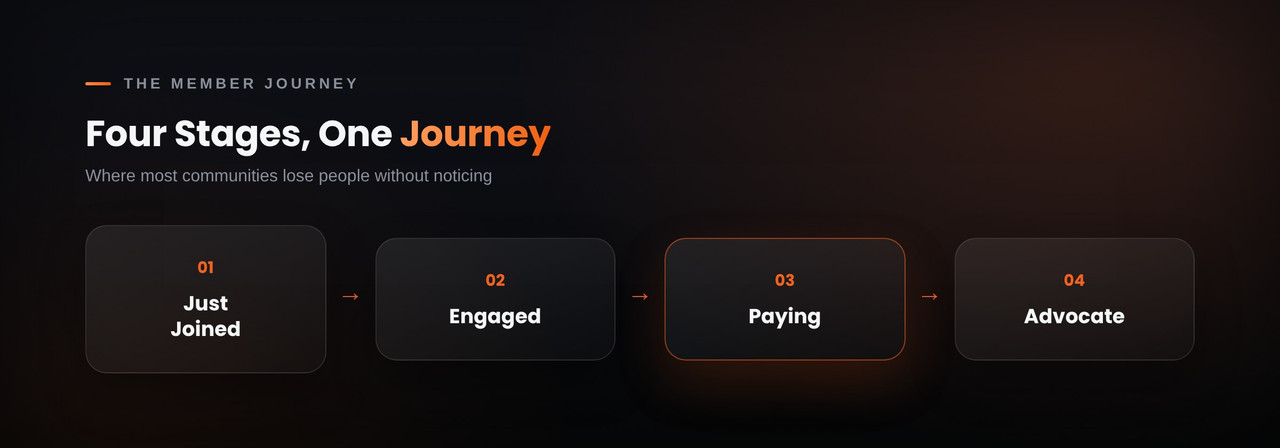
Strip away the jargon and every paid community's member journey looks roughly the same: someone just joined, they become engaged, they convert to paying, and (if things go well) they become an advocate who brings in the next round of members. Four stages, each with a different job to do and a different way of quietly failing.
Why this framework, and not a funnel
A sales funnel implies a straight line: people pour in the top, and a shrinking number trickle out the bottom as customers. Real communities don't behave that way. People plateau for months. They go quiet and come back on their own. They skip a stage entirely if the value is obvious enough. Treating the journey as a rigid funnel makes you panic at normal behavior and miss the moments that actually matter.
A journey, on the other hand, assumes movement in both directions. Someone can be "engaged" in month one and quietly slide back to "just joined" energy by month three if nobody's paying attention. That's not a broken member. That's a normal one, and it's exactly why ongoing attention beats a one-time onboarding checklist.
Why the middle matters more than the ends
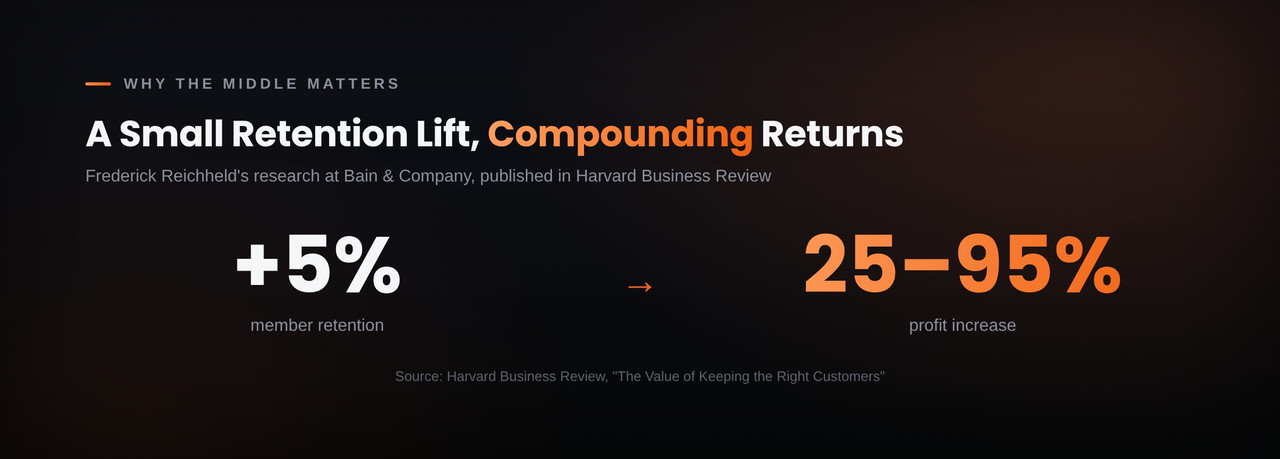
It's tempting to pour all your energy into the top of the journey (getting people to join) because that's the most visible, most trackable part. But retention research consistently shows the middle stages carry more weight than acquisition ever will. The underlying research here traces back to Frederick Reichheld, the Bain & Company fellow who effectively founded modern loyalty economics and later created the Net Promoter System. As Harvard Business Review reported on his research, increasing customer retention by just 5% can increase profits by 25% to 95%, depending on the business. That's not a typo. A small improvement in how well you hold onto the people you already have outperforms almost any realistic improvement in how many new people you bring in.
For a paid Discord community specifically, this shows up in a very literal way. A community that converts 10% of new joins but loses half of its paying members within three months is working twice as hard as it needs to. Fixing the middle of the journey, the part between "joined" and "paying," and between "paying" and "still here in six months," is nearly always the higher-leverage move.
This isn't unique to Discord communities either. David Spinks, cofounder of CMX and author of The Business of Belonging, built his entire framework for community strategy around the idea that a community's health is measured by member journeys, not by size. Companies like Airbnb and Udemy that Spinks has advised all treat the journey from new member to engaged contributor as the core metric worth optimizing, well ahead of raw headcount.
The journey isn't linear, and that's fine
One more thing worth sitting with before you go build a journey map: it's genuinely normal for members to skip stages, stall out, or double back. Someone might upgrade to paid within their first hour because the offer was obvious and they were already sold before they joined. Someone else might sit at "engaged but free" for four months, quietly lurking, before a single well-timed conversation finally moves them. Neither of those is a failure of your journey. The failure is not having a plan for either kind of member.
From Just Joined to Engaged
This is where most of the damage happens, and it happens fast. Community platform data suggests that as many as 15% of new members disengage or leave within their first day on a server. Whatever first impression you're making, you're making it in minutes, not days.
The generic welcome doesn't count
Discord's own built-in onboarding tools let you set default channels and ask new members a few questions to route them to relevant roles. That's useful plumbing, but plumbing isn't a welcome. A member who answers three onboarding questions and lands in a channel list still hasn't had a conversation. They've filled out a form. The difference matters enormously, because a form doesn't make anyone feel seen, and feeling seen is what keeps someone from quietly closing the tab.
Communities that manage this well tend to keep the automated onboarding lightweight (Discord's own guidance recommends capping it at three to five questions, since anything longer overwhelms new members before they've even reached the community itself) and pair it with something more personal: a real message that acknowledges why this specific person joined. For a deeper look at building that first sequence well, see how to onboard new members in a paid community.
What a good first hour actually looks like
Contrast two approaches. One large Discord community built around a well-known game runs new members through a deliberate three-stage process: accept the rules, get limited access to just a welcome and help channel, then unlock the rest of the server only after a short verification step. That structure stretches the first-touch experience to two or three minutes instead of the usual thirty seconds, which sounds small but gives the community a real window to make an impression instead of losing someone to a wall of unread channels.
The common thread across communities that retain well in week one isn't complexity, it's specificity. Ask why they joined. Point them at exactly one thing to do next, not a menu of twelve options. Get one small action out of them: a reply sent, an introduction posted, a question answered. Members who take a real action in their first session are dramatically more likely to still be around a month later than members who only lurk.
Where this stage usually breaks
The most common failure isn't a bad welcome message, it's silence after a good one. A warm greeting followed by nothing is often worse than no greeting at all, because it sets an expectation of personal attention that immediately gets broken. If your welcome promises a conversation, the conversation has to actually happen, and it has to happen for every single new member, not just the ones an admin happens to notice.
What "engaged" actually looks like in practice
It helps to define engagement concretely instead of leaving it as a vague feeling. A genuinely engaged member has usually done at least one of the following within their first week: posted an introduction, replied in a thread that wasn't started by an admin, reacted to or joined a live event, or asked a real question about the community's core offer. None of these are hard to achieve individually, but tracking whether they've happened for each new member, rather than assuming they have, is what turns "engagement" from a feeling into something you can actually manage. (More on what drives this in how to keep members engaged in a community.)
A simple diagnostic for this stage
If you're not sure whether your community is losing people at this exact point, look at the gap between total joins and members who've posted at least once. A large gap, sometimes half or more of new joins never posting a single message, is a clear sign the just-joined-to engaged transition is where members are falling out, not somewhere further down the journey. That's useful information, because it tells you to focus energy on the first hour, not on a later-stage retention campaign that's solving the wrong problem.
From Engaged to Paying
An engaged free member doesn't upgrade because you asked nicely, and they definitely don't upgrade because a pricing page exists somewhere in your server. They upgrade when they can see, specifically, what changes for them on the other side of the paywall.
Doubt is not rejection
Most free members who don't convert immediately aren't saying no. They're saying "not yet" or "I'm not sure this is for me specifically." Treating hesitation as a hard no is one of the fastest ways to lose someone who was actually close. The better move is treating this stage as an ongoing conversation, one where objections get real answers instead of silence, and where timing is respected rather than forced. (For the specifics of that conversation, how to turn free members into paying ones covers it in depth.)
This is also where the earlier journey work pays off. A member who felt genuinely welcomed in their first hour arrives at this stage with more trust already banked, which makes the eventual upgrade conversation feel like a natural next step rather than a pitch out of nowhere.
Handling the "not right now" without losing them
Not every engaged member is ready to pay today, and that's a fine outcome as long as you don't let them fall off entirely. This is exactly the moment where a lead magnet or a resource worth having on its own can keep someone warm: give them something real, ask when they'd want to revisit the offer, and actually follow up on that date. Members who eventually convert overwhelmingly convert because someone kept the door open at the right moment, not because they were chased relentlessly from day one.
What separates communities that convert well
The pattern across communities that convert free members efficiently isn't a better sales script. It's consistency: every engaged member gets a real conversation about the upgrade, not just the ones an admin happens to notice scrolling through recent messages. At scale, in a server with hundreds or thousands of new joins a month, that consistency is genuinely difficult to pull off by hand, which is exactly why this stage is where automated 1-on-1 conversation tools earn their keep.
From Paying to Advocate
This is the stage almost every community quietly skips, because it feels like the job is finished the moment someone's card is charged. It isn't. A paying member who stops feeling seen the day after they pay is a member who cancels three months later, usually citing "price" on the way out even though price was never really the issue.
The moment right after conversion matters more than people think
Think about the emotional arc from the member's side: they just made a decision, handed over money, and are looking for a signal that it was the right call. A generic "thanks for subscribing" role change is not that signal. A specific welcome to the paid tier, one that references what they were hoping to get out of it back when they first joined, is. This is the fastest way to turn "I hope this was worth it" into "I'm glad I did this."
Turning satisfaction into advocacy
Members become advocates when two things are consistently true: they keep getting real value, and they keep feeling like part of something rather than a name on a billing list. Word of mouth follows almost automatically from there. It's worth remembering that Discord itself grew to hundreds of millions of users largely through people inviting friends into servers they were already excited about, not through any paid campaign. That same dynamic plays out at the scale of a single community: happy, seen members become the growth engine, without you ever having to ask.
The compounding effect of getting this right
A community that nails this last stage doesn't just retain better, it grows differently. Instead of a growth strategy that depends entirely on new discovery, it starts benefiting from a standing base of paying members who bring in the next wave themselves. That's the version of a member journey worth building toward: not a straight line from stranger to customer, but a loop that keeps feeding itself.
Common Mistakes Communities Make With the Member Journey
A few patterns show up again and again in communities that struggle to move members through this journey, even when individual pieces, the welcome message, the pricing, the content, all look fine in isolation.
- Treating the journey as something that only needs attention once. Plenty of admins put real effort into the welcome flow, get it working well, and then stop thinking about the journey entirely, assuming a good first hour guarantees everything downstream. It doesn't. Each stage needs its own ongoing attention, not a one-time setup.
- Measuring the wrong thing at each stage. Total member count tells you almost nothing about journey health. What matters is the transition rate between stages: what share of new joins actually engage, what share of engaged members convert, what share of paying members are still active three months later. Tracking totals instead of transitions hides exactly where the journey is breaking.
- Assuming every member wants the same pace. Some admins build a single, fixed sequence, welcome message on day one, offer on day three, follow-up on day seven, and apply it identically to everyone. Members who were ready to convert on day one get slowed down waiting for day three, and members who needed three weeks get rushed. A more flexible approach, responsive to where each member actually is, consistently outperforms a fixed schedule.
- Letting the paying stage go quiet. This is the single most common mistake, and it's covered above for good reason: communities pour disproportionate effort into everything before the sale and comparatively little into what happens after. Given that a paying member who feels unseen is the most likely person to quietly churn, this imbalance is expensive.
Mapping Your Own Journey This Week
If you've never mapped your community's journey explicitly, it's worth doing as a standalone exercise rather than trying to hold it all in your head. A simple way to start:
- Pull your last 100 new joins. Not a random sample, the most recent 100, since that reflects what's actually happening right now, not what worked a year ago.
- Sort them into the four stages. Just joined and inactive, engaged but free, paying, and paying-plus-referring. Be honest about where each one actually falls, not where you wish they were.
- Look at the size of each group. A journey with a huge cluster stuck at "just joined, never engaged" points to a first-hour problem. A cluster stuck at "engaged but never paying" points to a conversion problem further down.
- Pick one transition to improve first. Trying to fix every stage at once usually means none of them get fixed well. Find the single biggest cluster and focus there for a month before moving to the next one.
This exercise takes an afternoon for most communities and tends to be more revealing than any dashboard, because it forces a genuinely honest look at where real people actually are, rather than an aggregate number that hides the gaps.
Quick FAQ
- How long should the member journey take, from joining to paying?
There's no universal number, and treating one as a target usually backfires. Some members convert within their first conversation because the fit was obvious. Others need weeks of genuine engagement first. What matters is having a real plan for both, rather than assuming everyone should move at the same speed.
- What's the single biggest sign a member's journey has stalled?
A drop in activity that's easy to miss because nothing dramatic happens. No complaint, no cancellation, just fewer messages, fewer reactions, fewer logins. That quiet flattening is the earliest and most reliable warning sign, well before anyone actually leaves.
- Does every member need to reach the "advocate" stage?
No, and expecting that is unrealistic. Plenty of members stay happily engaged or paying without ever referring anyone, and that's a perfectly healthy outcome. The advocate stage is a bonus layer on top of a healthy journey, not a requirement for the journey to be considered successful.
- Is it worth mapping the journey for a small community?
Especially for a small one. A 50-member community can track this by hand, an admin remembering roughly where everyone stands. The value of mapping it explicitly is that it forces you to notice the member who's quietly stalled between "engaged" and "paying" before they drift out entirely, something that's easy to miss even at a small scale when you're juggling everything yourself.
- Can a member move backward in the journey, from paying back to just engaged?
Yes, and it happens more often than most admins realize. A paying member who stops feeling seen or stops getting consistent value can slide back into a disengaged state well before they actually cancel. Watching for that backward slide is arguably more valuable than watching for forward progress, since it's the earliest possible warning of churn.
- Does the journey look different for a free community versus a paid one?
The shape is similar, but the stakes at the "engaged to paying" transition obviously don't exist for a free community. That said, free communities still have an equivalent transition worth tracking, engaged member to genuine advocate, since that's usually where free communities eventually monetize, whether through sponsorships, upsells, or a future paid tier.
Further Reading
- The Business of Belonging by David Spinks (CMX) — the definitive framework for mapping community member journeys to business outcomes
- Harvard Business Review: "The Value of Keeping the Right Customers" — the original 5%- retention-to-25-95%-profit data
- Fred Reichheld's biography and body of work — background on the researcher behind that data
- Discord's own Community Onboarding guide — the mechanics of setting up default channels and onboarding questions
- Mava's Discord onboarding research — data on structured onboarding across 1,000+ communities
Mapping your own journey honestly tends to surface the same finding for most admins: the gap isn't at the very top, and it isn't at the very bottom. It's somewhere in the crowded middle, where members are quietly falling through with nobody actually there to catch them.
That middle stretch, from a fresh join to a real conversation to an actual upgrade, is exactly the gap SalesGenie was built to close. It opens a genuine 1-on-1 thread with every new member the moment they join, carries them through onboarding and objection-handling, and keeps that same conversation open long after they convert. Book a demo to see what it looks like inside your own server.