

Why Members Cancel, and How to Keep Them
Ask most community admins why members cancel and you'll get the same answer almost every time: price. It's the easiest reason to accept, because it doesn't ask you to look any closer at how the community itself is running. It's also, in most cases, not the real reason at all.
Membership businesses lose members every month whether anyone's watching or not. Recent benchmark data on membership communities puts average monthly churn around 5.8%, which compounds to roughly half the membership base disappearing over a full year if nothing is done to address it. This tracks with the broader retention research pioneered by Frederick Reichheld at Bain & Company, whose original studies found that U.S. businesses lose roughly half their customers every five years on average, and that most of that loss traces back to preventable causes rather than inevitable attrition. The specific reasons behind community cancellations are far more actionable, and far less about price, than most cancellation surveys suggest.
The Real Reasons Behind Cancellations
There's a useful distinction worth borrowing from customer success circles: the reasons companies think customers churn are rarely the reasons they actually churn. Teams often assume price, or a missing feature, or a champion leaving. The real drivers, once you dig in, are usually about fit, engagement, and whether the value ever fully landed in the first place. Paid communities follow the same pattern.
Engagement, not price, is the biggest driver
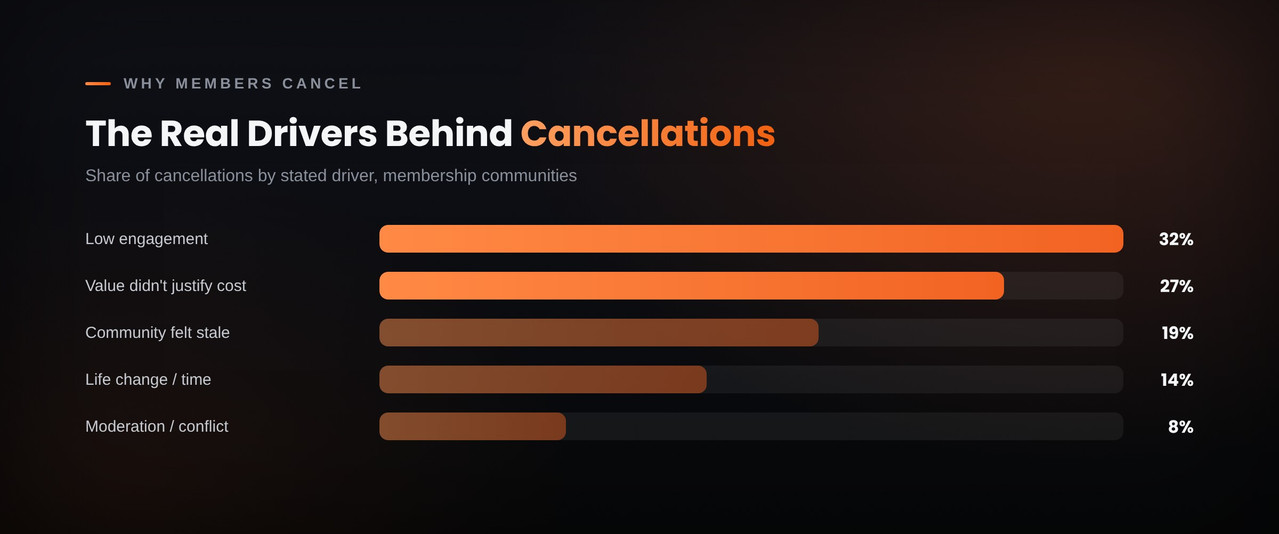
Data specific to membership communities shows the single largest cancellation driver is low engagement, members who simply stopped participating, accounting for close to a third of all cancellations. Close behind that, at just over a quarter, is a sense that the value no longer matches what they're paying, which sounds like a pricing problem but is really a value-delivery problem wearing a pricing costume.
The quieter reasons that add up
Beyond those two, a meaningful chunk of cancellations trace back to the community itself feeling stale or repetitive, life circumstances eating into the time someone has available, and, less often but still real, a poor moderation experience souring the relationship. None of these show up as a single dramatic event. They build slowly, over weeks, which is exactly why they're so easy for a busy admin to miss until the cancellation email shows up. (The early version of this same pattern is covered in why new members join and then disappear.)
Moderation and conflict deserve more attention than their small share suggests
Moderation issues sit near the bottom of the driver list by volume, but they carry outsized weight in a different way: a single bad moderation experience can push out not just the affected member but the people who witnessed it, quietly, without ever posting about it publicly. A member who watched a disagreement get handled badly in a public channel doesn't always say anything, they just get a little more hesitant to engage, and that hesitation compounds. This is worth taking seriously even though the raw percentage looks small, because its ripple effect is larger than the number alone suggests.
The signals worth watching, concretely
Beyond raw message counts, a few specific signals tend to precede cancellation reliably: a member who stops reacting to messages they'd normally engage with, someone who's stopped showing up to recurring events they used to attend consistently, and someone whose replies have gotten noticeably shorter or less enthusiastic over a few weeks. None of these alone means much. Together, and sustained over three or four weeks, they're a strong enough signal to warrant a genuine, personal check-in.
The forms people fill out lie, gently
Cancellation forms almost always list "too expensive" as an option, and people click it, because it's socially the easiest box to check. Admitting "I stopped getting value out of this" or "I forgot why I even joined" feels more uncomfortable to write down, even anonymously. So price becomes the stated reason for a decision that was actually made weeks earlier, the moment engagement quietly dropped off.
A useful way to read a cancellation survey
Rather than taking the top answer at face value, cross-reference it against that member's actual activity in the weeks before they left. If someone who cited "price" had also gone quiet for a month beforehand, price almost certainly wasn't the real story, disengagement was, and price was just the easiest label to attach to it on the way out. If someone who cited price was still highly active right up until they cancelled, that's a genuinely different situation, and might actually warrant a pricing conversation. The stated reason means very little without that context.
Subscription fatigue is real, but it's rarely the whole story
It's worth acknowledging that broader subscription fatigue is a real phenomenon; people are juggling more recurring payments than ever, and cost-cutting has become a more common stated reason for cancelling almost anything in recent years. But fatigue tends to hit the subscriptions people were already ambivalent about first. A community someone is genuinely engaged with and getting real value from is far more resistant to being cut in a fatigue-driven budget review than one they'd already quietly stopped using.
Why It's Rarely About Price
This distinction matters enormously for what you actually do about it. If price really were the core problem, the fix would be straightforward: discount, or hold the line and accept the churn. Since it usually isn't the core problem, chasing a pricing fix solves the wrong thing entirely.
Price sensitivity is a symptom, not a cause
People rarely quibble over the cost of something they're still excited about. The complaint about price tends to surface only after the excitement has already faded, which means by the time someone mentions cost, the real problem, disengagement, has usually been building for a while already. Treating the symptom (discounting) without addressing the cause (declining engagement) is a short term patch at best.
What this means for how you read your own churn data
If you're staring at a cancellation reason list dominated by "price," resist the urge to immediately reach for a pricing change. Look one layer deeper first: were these members actually engaged in the weeks before they cancelled, or had their activity already been quietly tapering off? That answer tells you far more about the real fix than the stated reason ever will.
Building Something Members Won't Leave
Members stay when two things stay true, consistently, not just at the moment they signed up: they're still getting something real, and they still feel like part of something, not a name on a billing list.
Consistent value on a rhythm they can count on
Sporadic bursts of great content followed by long stretches of quiet don't build the kind of reliability that keeps people paying month after month. A community members won't leave tends to have a rhythm, something happening on a schedule people can anticipate, even if it's modest. Predictability builds trust in a way that occasional brilliance doesn't.
Being noticed, even at scale
This is the part that gets harder as a community grows, and it's also the part that matters most. A member who feels individually noticed, through a reply, a check-in, a "how's it going" that references something specific about them, is dramatically less likely to quietly drift than one who feels like an anonymous face in a crowd of thousands. Scale makes this genuinely difficult to do by hand, which is a large part of why it's so often the first thing that slips as a community grows. (How to keep members engaged in a community goes deeper on building that habit at scale.)
Belonging beyond the content itself
Communities that retain well tend to give members reasons to stay that go beyond the core content or offer. Shared rituals, running jokes, recurring events, the kind of thing that only makes sense if you've been around a while, create a sense of belonging that's much harder to walk away from than a subscription to information alone. That's worth its own deeper dive; the short version is that culture retains people longer than content does.
A worked example of reading past the stated reason
Picture a member who cancels and cites "too expensive" in the exit survey. Looking back at their activity, they posted actively for the first six weeks, then went almost completely silent for the month before cancelling. Nothing about their financial situation necessarily changed in that window, what changed was their engagement. The actual retention opportunity here wasn't a discount, it was a check-in around week seven, when the drop off first started, well before "too expensive" ever became the reason they'd write down. This is the pattern worth training yourself to look for across your own cancellations: the stated reason and the actual timeline of disengagement, read side by side.
Practical tactics that show up again and again
A few concrete moves come up repeatedly across communities that have actually reduced cancellations rather than just talked about it: a short video or note on the cancellation page reminding someone what they built and what they'll be walking away from, identifying an early "activation point," the first small win that signals someone is genuinely engaged, and prioritizing that in onboarding, and rotating your best content back into view so members are reminded of value they might have missed the first time around. None of these are expensive. They're just consistent, and consistency is exactly what tends to slip once the initial launch energy wears off.
Member Retention as a Habit
Retention isn't a save campaign you run the moment someone clicks cancel. By that point, you're negotiating with someone who's already emotionally checked out, and the odds of changing their mind have dropped considerably. Real retention gets built much earlier, in the onboarding, in the everyday engagement, and in the quiet check-ins that happen long before anyone's thinking about leaving. (For the more tactical, week-by-week version of this, see how to reduce member churn in a paid community.)
Voluntary versus involuntary churn
It's worth separating two very different problems that both show up as "a member left." Voluntary churn is someone actively deciding to go. Involuntary churn is a failed payment quietly ending the relationship without anyone deciding anything. The second kind is often the cheapest to fix: a simple update-your-payment-info nudge recovers a meaningful share of these members, since most of them never intended to leave in the first place. It's worth checking your own numbers here before assuming every cancellation was a considered decision.
Treat it as a daily practice, not a monthly report
Communities that keep churn low tend not to think of retention as a metric they check at the end of the month. They think of it as something they're doing every single day, in every interaction, long before any number needs reviewing. Build that habit, and the cancellations you do see will genuinely be the ones you couldn't have prevented, not the ones nobody noticed coming.
What a daily retention habit actually looks like
In practice, this doesn't require a dashboard or a dedicated retention team, even for a solo admin. It looks like scanning recent activity for members who've gone unusually quiet, sending a handful of genuine check-ins each week rather than waiting for a monthly campaign, and treating every new member's first month as a critical window rather than assuming they're set once onboarding is technically complete. Communities that run at scale often build this into an automated system precisely because a human doing it by hand, however well-intentioned, tends to notice only the loudest signals and miss the.quiet ones, which is exactly where retention is won or lost.
Quick FAQ
- What's a healthy monthly churn rate for a paid community?
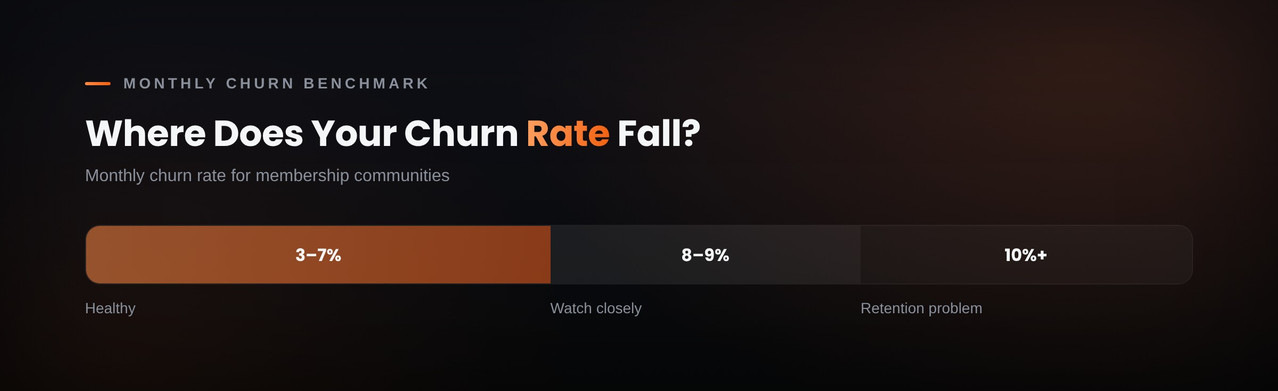
Estimates for membership communities generally put a healthy range somewhere between 3% and 7% monthly. Rates climbing meaningfully above that usually point to a specific, fixable issue in onboarding, engagement, or audience fit rather than an unavoidable cost of doing business.
- Should I always believe the reason members give when they cancel?
Treat it as one data point, not the full picture. Stated reasons, especially "too expensive," are often a socially easier way of describing a deeper disengagement that happened weeks earlier. Cross-reference it against that member's actual activity in the month before they left.
- Is member retention mostly a moderation and community-culture problem, or a product problem?
For most paid Discord communities, it's overwhelmingly a culture and engagement problem, not a features problem. The communities that retain best usually aren't the ones with the most tools, they're the ones where members consistently feel seen and consistently get real value on a predictable rhythm.
- How quickly should I act on a drop in a member's engagement?
As early as you can reasonably notice it. A member whose activity has flattened for two to four weeks is showing you a warning sign well before they'd ever consider cancelling. Reaching out at that point is a fundamentally easier conversation than trying to win someone back after they've already decided to leave.
- Is it worth running exit interviews or surveys for every cancellation?
For communities of any real size, yes, even a short, optional one-question survey. The value isn't any single response, it's the pattern across dozens of them over time, which tells you far more about systemic issues than any individual cancellation reason ever could.
- Does member retention differ meaningfully by niche, like trading versus coaching versus reselling communities?
The underlying psychology is remarkably consistent across niches: engagement and perceived value drive retention everywhere. What differs is the specific content of "value." A trading community's value might be measured in signal accuracy and timeliness, a coaching community's in visible personal progress, a reselling community's in deal flow. The retention principles stay the same; what counts as delivering on them looks different in each case.
- Should I focus more on preventing churn or on winning back members after they cancel?
Prevention, by a wide margin. Every dollar and hour spent on early engagement and recognition prevents a cancellation before it happens, which is nearly always cheaper and more reliable than trying to win someone back afterward. Win-back efforts are worth having, but they should be the safety net, not the primary strategy.
Further Reading
- RetentionCheck's churn benchmarks for membership communities — the source for the monthly churn and driver percentages cited above
- Fred Reichheld's loyalty economics research — the original Bain & Company studies on why customers actually leave
- The subscription churn note from Yem Jam — a real breakdown of voluntary versus involuntary cancels from a team that worked on retention at Hulu and Crunchyroll
- Recurly's research on cancellation flows — data on pause behavior versus full cancellation
Spotting a member who's quietly disengaging, in real time, across hundreds of parallel conversations, is more than any single admin can track by hand, which is exactly why so much of this work falls through the cracks in growing communities. The communities that keep churn low aren't the ones with the fanciest tools, they're the ones that treat retention as something to protect every day, not just something to measure once a month.